
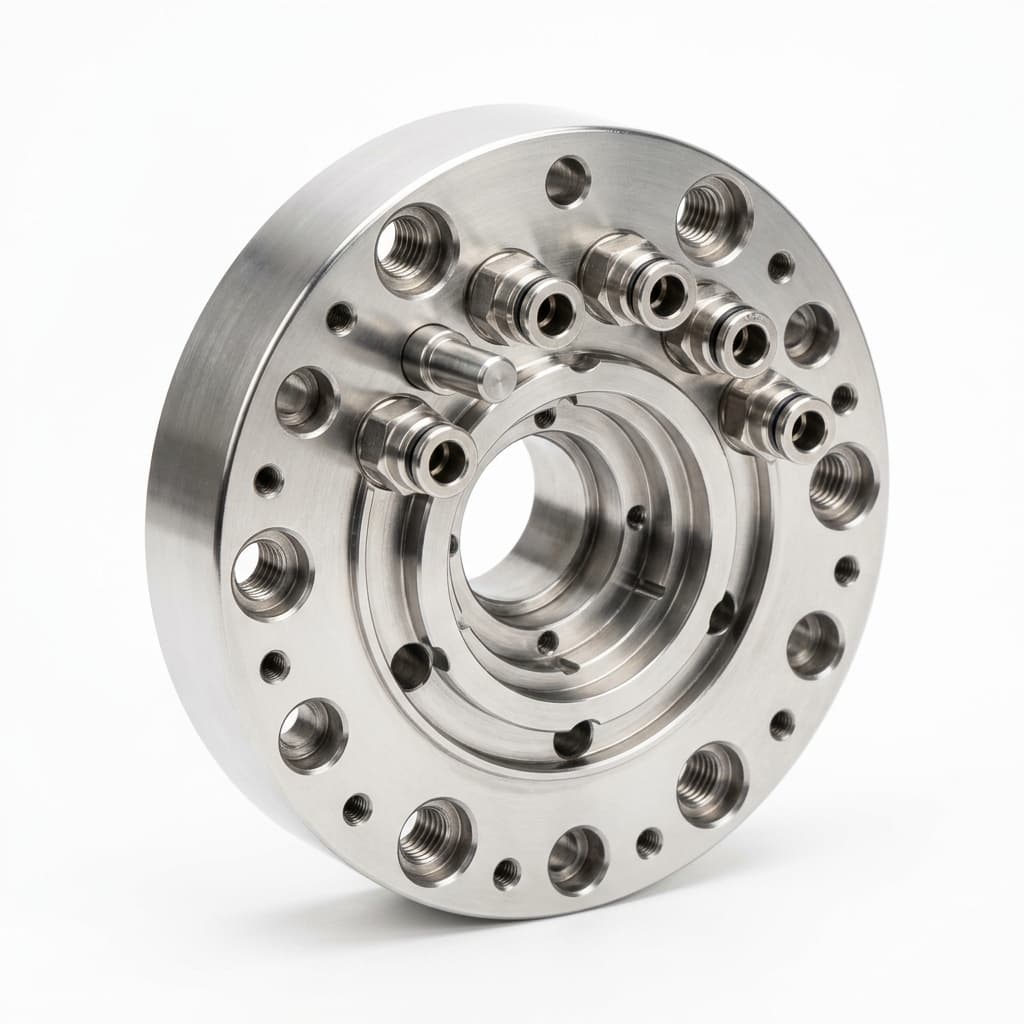
304 Stainless Steel Tool Changer Adapter Plate
Calculate the payload impact of 304 SS versus AL6061 and learn when to specify stainless steel for your robotic automatic tool changer (ATC) interface. For general end-of-arm tooling guides, see our 304 Stainless Steel End Effector Adapter Plate page. For harsher washdown environments, refer to our 316 Stainless Steel End Effector Adapter Plate guide.
Reviewed July 26, 2026
Inquiry Email
Attach your CAD files (STEP, IGES) and tolerances for quick quoting.
Payload Weight Calculator
Start with dimensions, robot payload, and the mass of your tool changer and EOAT. The result explains whether a 304 stainless adapter plate is payload-safe, tight, or overloaded before you invest in a quote.
Key Takeaways
- Weight Penalty: 304 SS is roughly 3x heavier than AL6061-T6. A standard 150x150x15mm plate weighs ~2.7kg in 304 SS, which combined with a heavy tool changer can severely limit cobot payloads.
- Hygiene & Compliance: Essential for food-grade and pharmaceutical environments when the customer specification calls for corrosion resistance, washdown durability, and a hygienic surface finish.
- Machining & Tolerances: Tool changers require precise dowel alignment. 304 SS is tougher and work-hardens, so quoting must account for controlled machining to hit tight true-position tolerances without warping.
- Decision Rule: choose 304 when washdown or customer material rules are mandatory, choose 316L when chlorides are credible, and choose AL6061-T6 when payload margin is the controlling requirement.
How to Decide Before Quoting
Treat the calculator as the first screen, not the final engineering release. A 304 stainless steel tool changer adapter plate is usually justified by environment and customer specification, then checked against robot payload and machining cost.
| Method Step | What to Check | Decision Boundary |
|---|---|---|
| 1. Screen mass | Use the calculator to compare a rectangular 304 stainless blank against AL6061-T6. | The number excludes pockets, counterbores, inserts, dowels, fasteners, and tool-changer hardware. |
| 2. Check exposure | Classify the line as dry, splash, washdown, chloride-heavy, or cleanroom before choosing 304. | Strong bleach, brine, high-salt food, marine exposure, and warm crevices can push the design toward 316L. |
| 3. Quote manufacturability | Call out surface finish, passivation/electropolish (ASTM A967), ISO 9409-1 datum scheme, and inspection evidence. | A generic stainless note is not enough for sanitary or repeatable robot interface work. |
304 Stainless Steel vs AL6061-T6 for Tool Changers
While 304 stainless steel offers superior corrosion resistance and wear durability (which is beneficial for frequently actuated tool changers), its weight often pushes engineers toward AL6061-T6 for general automation.
| Property | 304 Stainless Steel | AL6061-T6 |
|---|---|---|
| Density | 8.00 g/cm³ | 2.70 g/cm³ |
| Tensile Strength | ~505 MPa | ~310 MPa |
| Corrosion Resistance | Strong general corrosion resistance; confirm 316L for chloride-heavy washdown | Good (Anodizing recommended) |
| Typical Machining Speed (SFM) | ~150–250 SFM; work hardening makes tooling and coolant strategy critical | ~600–1000 SFM; usually much faster cycle time for comparable geometry |
| Machinability | Moderate; avoid rubbing cuts and poor chip evacuation | Excellent |
| Best Used For | Washdown environments, cleanrooms, highly stressed ATC joints | Standard payload-sensitive tool changers |
Material Choice by Use Condition
This page targets 304 stainless steel, but a good sourcing decision must also say when not to use it. Use this table to keep the primary keyword intent aligned with practical EOAT material selection.
| Use Condition | Recommended Baseline | Why It Fits |
|---|---|---|
| Dry or lightly wiped general automation | AL6061-T6 or hard-anodized aluminum | Usually gives the best payload margin, machining speed, and cost for non-washdown adapter plates. |
| Routine water washdown, mild cleaners, stainless customer spec | 304 stainless steel | Useful when corrosion resistance and cleaning durability matter more than the weight penalty. |
| Chlorides, bleach, brine, high-salt food, or marine exposure | 316L stainless steel | Molybdenum-bearing stainless is the safer starting point for chloride pitting resistance. |
| Small cobot or high-acceleration pick cycle | Pocketed 304 only if stainless is mandatory | Mass can consume payload and reduce acceleration; verify final CAD mass and tool changer derating. |
Design Risks & Mitigation
Risk: Overloading the Robot
Specifying a 304 SS adapter plate along with a heavy tool changer can consume the allowable payload of smaller robots, leading to servo faults or reduced acceleration.
Mitigation: Pocketing & FEA
If 304 SS is strictly required for hygiene or rigidity, use pocketing (removing non-structural material) where the load path allows it. Verify final mass, stiffness, and robot dynamics from CAD and FEA before release.
| Risk | Decision Impact | Mitigation |
|---|---|---|
| Payload overrun | Servo faults, reduced acceleration, or forced robot upsizing | Run the calculator first, then verify final CAD mass with fasteners and tool-changer hardware included. |
| Wrong stainless grade | Pitting or staining in chloride-heavy washdown | Document chemicals, concentration, temperature, dwell time, and crevice exposure before approving 304. |
| Unquoted finish work | Supplier variance, late cost changes, or failed hygiene review | Put Ra target, edge break, passivation/electropolish (e.g., ASTM A967), and inspection method directly on the drawing. |
| Interface stack-up | Robot flange, tool changer, dowels, or gripper pattern fails to align | Provide robot model, tool changer model, bolt circle, dowel scheme, datum references, and the specific ISO 9409-1 standard dimension. |
Evidence, Standards & Application Boundaries
Last verified: July 2026. Public material data and standards guidance are useful for screening, but the buyer's robot model, plant chemicals, drawing notes, and quality plan decide the final material and finish. Always cross-reference with official standards like ISO 9409-1 for flanges and ASTM A967 for passivation.
Sanitary Design & Flange Compliance
Organizations like EHEDG and 3-A Sanitary Standards influence hygienic geometry and cleanability, while ISO 9409-1 dictates the mechanical interface for robotic flanges. Put the exact Ra target, passivation requirement (e.g., ASTM A967), and dimensional tolerances on the drawing.
The Chloride Boundary
304 SS can pit in chloride-heavy environments, especially with crevices, heat, long dwell time, or aggressive sanitizers. If the line sees strong bleach, brine, marine exposure, or high-salt foods, price 316L as the safer baseline.
| Claim Used | Screening Value | Traceable Source Type | Boundary |
|---|---|---|---|
| Robot mechanical interface standard | ISO 9409-1:2004 | ISO: Manipulating industrial robots — Mechanical interfaces | Defines main dimensions and dowel pinning for circular plates; required for repeatable tool changer mating. |
| Chemical passivation standard | ASTM A967 / A967M-25 | ASTM: Standard Spec for Chemical Passivation of Stainless Parts | Specify nitric or citric acid treatment; critical for food/medical grade acceptance to remove free iron. |
| 304 stainless density used by the calculator | 8.0 g/cm3 | AZoM: Stainless Steel 304 material data | Use final CAD mass properties when the plate has pockets, counterbores, dowel holes, or inserts. |
| AL6061-T6 density used by the calculator | 2.7 g/cm3 | AZoM: Aluminium / Aluminum 6061 alloy data | Use the actual alloy temper and any coating or hard-anodize thickness for final weight review. |
| Sanitary surface finish target | Ra 0.8 um / 32 uin is a common hygienic-design target | 3-A Sanitary Standards primer on surface finish criteria | Treat as an RFQ requirement to confirm, not universal certification evidence. |
| Chloride exposure boundary | 304 stainless is vulnerable to localized chloride pitting | BSSA: stainless selection for chlorine exposure | Bleach concentration, temperature, dwell time, crevices, and cleaning cycle decide whether 316L is safer. |
| Machining penalty versus aluminum | ~150–250 SFM (45–75 m/min) for 304 vs ~600–1000 SFM for 6061 | Sandvik Coromant stainless steel milling application guidance | 304 SS machines significantly slower (approx. 45% machinability rating) due to work hardening; impacts cost. |
RFQ Inputs That Change the Quote
A useful RFQ for a 304 stainless steel tool changer adapter plate should include the checks below. Without them, the quote usually hides risk in assumptions about mass, finish, and interface fit.
Tool changer model & payload
Payload margin and bolt/dowel pattern compatibility for both robot side and tool side (check ISO 9409-1).
CAD model or drawing
Pocketing, hole features, tolerances, and final mass.
Washdown chemicals
Whether 304 is acceptable or 316L is safer for tool changer environments.
Surface finish & passivation target
General machined finish versus hygienic polish/electropolish (e.g., ASTM A967).
Interface standard
Robot flange (ISO 9409-1), tool changer (e.g. ATI, Schunk), dowel pattern, and fastener class.
Inquiry Email
Attach your CAD files (STEP, IGES) and tolerances for quick quoting.
Related EOAT Sourcing Checks
Use these adjacent pages to validate the material callout, machining route, and quality evidence around the tool changer adapter plate.
Tool changer adapter plates
Review machining, inspection, and RFQ expectations for custom quick-change interface plates.
Material sourcing checks
Compare stainless, aluminum, and documentation requirements before locking the drawing note.
Inspection and quality evidence
Plan dimensional reports, material records, and surface-finish evidence for buyer review.
CNC machining capabilities
Check the operations that affect pocketing, counterbores, datum features, and finish work.
304 stainless EOAT mounting plate
Compare the broader robot wrist mounting-plate decision before specifying a tool changer plate.
304 stainless EOAT bracket
Use the adjacent bracket guide when the stainless part is carrying a cantilevered EOAT load.
304 stainless vacuum manifold
Check sealing, washdown, and payload tradeoffs when utilities move through the EOAT stack.
Frequently Asked Questions
When is 304 stainless worth the payload penalty for tool changers?
Use 304 when washdown durability, corrosion resistance, customer material rules, or cleanability are stronger requirements than cycle-time acceleration and low mass. Tool changers often have tight mating tolerances where stainless prevents wear.
When should I choose 316L instead?
Choose 316L for chloride-heavy cleaners, brine, high-salt foods, marine exposure, warm crevices, or customer specs that explicitly require molybdenum-bearing stainless.
Can aluminum still pass a food or medical automation review?
Sometimes, but it depends on the customer standard, coating, wear exposure, cleaning chemistry, and whether the plate contacts the product zone. Do not assume anodized aluminum is acceptable without the drawing note and compliance review.
Does a 304 stainless tool changer adapter plate require passivation?
For general automation it may not be required, but passivation is often requested for cleanroom, food, pharmaceutical, or corrosion-sensitive programs. Put the requirement and acceptance method in the RFQ.
How accurate is the calculator for tool changer plates?
It is a screening estimate for a rectangular blank. Final mass must come from CAD after pockets, holes, counterbores, inserts, dowels, pneumatic pass-throughs, fasteners, and purchased tool changer hardware are included.
What tolerance should an adapter plate use?
Use the robot flange, dowel, tool changer, and gripper interface as the tolerance drivers. Avoid blanket tight tolerances; call out datum-controlled features where repeatability matters, especially for ATC alignment.
Should I pocket a 304 tool changer adapter plate?
Pocket it when payload margin is tight and the sanitary or corrosion requirement still favors stainless. Keep enough material around dowels, threaded inserts, sealing faces, and high-load tool changer features so stiffness and repeatability are not traded away.
Can the plate replace a purchased tool changer tool plate?
Usually no. Treat the purchased tool changer plates, master/tool halves, and manufacturer safety features as fixed unless the tool changer supplier approves the change. This page is for the custom interface plate between those components and the EOAT.
What surface finish should the drawing call out?
For sanitary or washdown work, specify the required Ra target, deburring, edge break, and passivation or electropolish method. For dry automation, a general machined finish may be enough if corrosion and cleaning are not drivers.
How should utility pass-throughs affect the estimate?
Add pneumatic, vacuum, electrical, sensor, and cable management features before approving mass. They can remove material from the plate but often add fittings, connectors, guards, or manifolds that increase the full EOAT load.
What makes 304 more expensive to machine than aluminum?
304 work-hardens and usually needs more controlled cutting, coolant, chip evacuation, and inspection time than AL6061-T6 on comparable geometry.
What should I send for an RFQ?
Send 3D CAD, 2D drawing, robot model, tool changer model, payload, other EOAT mass, washdown chemicals, surface finish target, passivation/electropolish notes, and interface hardware requirements.
Ready to Manufacture Your Tool Changer Adapter Plate?
Send us your 3D CAD models. We will review material choices, tool changer alignment, payload considerations, and provide a DFM-optimized quote.
Inquiry Email
Attach your CAD files (STEP, IGES) and tolerances for quick quoting.