
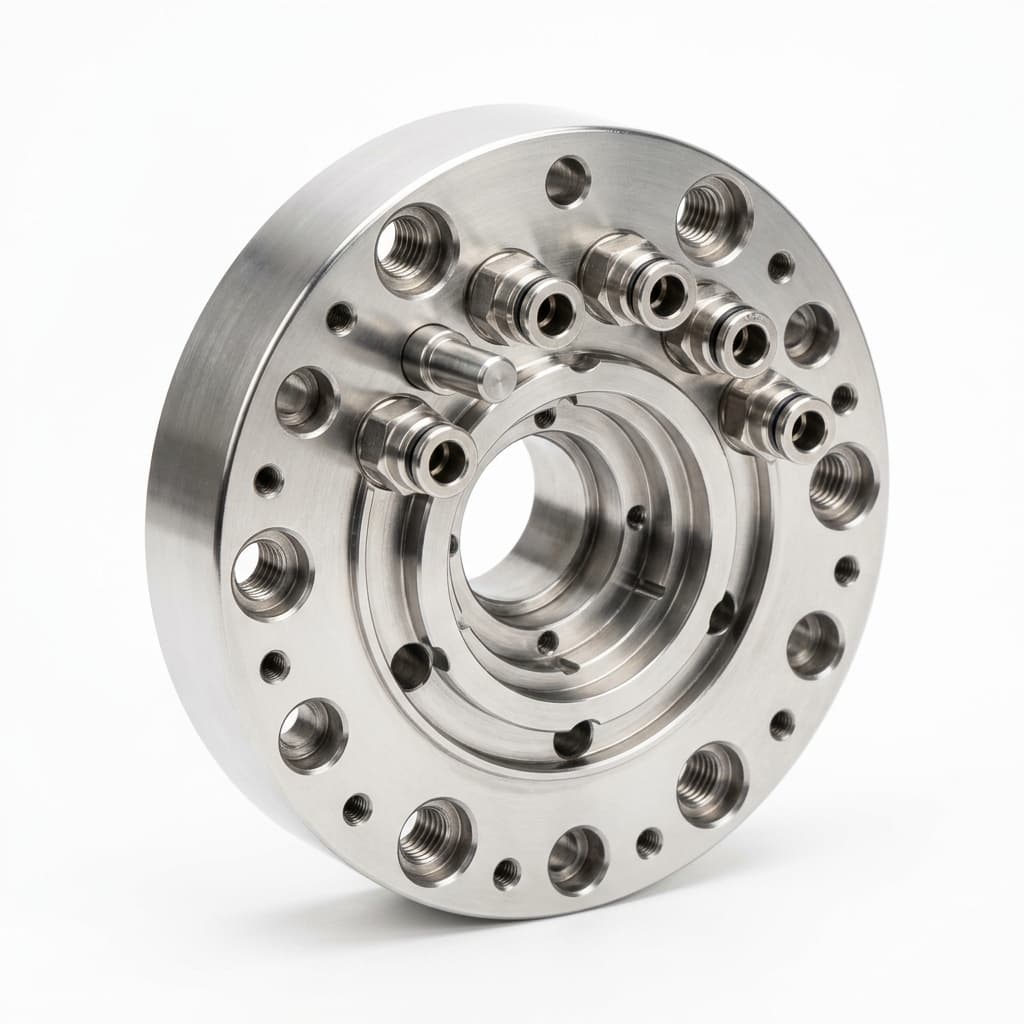
304 Stainless Steel EOAT Mounting Plate
Calculate the payload impact of 304 SS versus AL6061 and learn when to specify stainless steel for a robot wrist, tool changer, gripper frame, or washdown EOAT mounting interface. If the buyer calls the same interface an adapter, compare the adjacent 304 stainless steel EOAT adapter plate guide after this mounting-plate check.
Reviewed July 18, 2026
Inquiry Email
Attach your CAD files (STEP, IGES) and tolerances for quick quoting.
Mounting Plate Payload Weight Calculator
Start with dimensions, robot payload, and other EOAT mass. The result explains whether a 304 stainless mounting plate is payload-safe, tight, or overloaded before you invest in a quote.
Key Takeaways
- Weight Penalty: 304 SS is roughly 3x heavier than AL6061-T6. A standard 150x150x15mm plate weighs ~2.7kg in 304 SS, consuming over 50% of a 5kg cobot payload.
- Hygiene & Compliance: Essential for food-grade and pharmaceutical environments when the customer specification calls for corrosion resistance, washdown durability, passivation, and a hygienic surface finish such as Ra 0.8 um / 32 uin.
- Machining Costs & Work Hardening: 304 SS rapidly work-hardens and has low thermal conductivity. Quoting should expect lower cutting speeds, rigid fixturing, sharp tooling that "cuts rather than rubs", and more inspection time than a comparable aluminum plate.
- Assembly & Galling Risk: Threading 304 stainless bolts into a 304 plate has a high risk of cold welding (galling). Always specify anti-seize lubricants, mixed alloy grades (e.g. 316 bolts), and slow assembly speeds.
- Decision Rule: choose 304 when washdown or customer material rules are mandatory, choose 316L when chlorides are credible, and choose AL6061-T6 when payload margin is the controlling requirement.
How to Decide Before Quoting
Treat the calculator as the first screen, not the final engineering release. A 304 stainless steel EOAT mounting plate is usually justified by environment and customer specification, then checked against robot payload, interface repeatability, and machining cost.
| Method Step | What to Check | Decision Boundary |
|---|---|---|
| 1. Screen mass | Use the calculator to compare a rectangular 304 stainless blank against AL6061-T6. | The number excludes pockets, counterbores, inserts, dowels, fasteners, and tool-changer hardware. |
| 2. Check exposure | Classify the line as dry, splash, washdown, chloride-heavy, or cleanroom before choosing 304. | Strong bleach, brine, high-salt food, marine exposure, and warm crevices can push the design toward 316L. |
| 3. Quote manufacturability | Call out surface finish, passivation/electropolish, tolerance datum scheme, and inspection evidence. | A generic stainless note is not enough for sanitary or repeatable robot interface work. |
304 Stainless Steel vs AL6061-T6
While 304 stainless steel offers superior corrosion resistance and hygiene, its weight and machinability often push engineers toward AL6061-T6 for general automation.
| Property | 304 Stainless Steel | AL6061-T6 |
|---|---|---|
| Density | 8.00 g/cm³ | 2.70 g/cm³ |
| Tensile Strength | ~505 MPa | ~310 MPa |
| Corrosion Resistance | Strong general corrosion resistance; confirm 316L for chloride-heavy washdown | Good (Anodizing recommended) |
| Typical Machining Speed (SFM) | Lower; work hardening makes tooling and coolant strategy critical | Higher; usually faster cycle time for comparable geometry |
| Machinability | Moderate; avoid rubbing cuts and poor chip evacuation | Excellent |
| Best Used For | Washdown environments, cleanrooms, high-stress joints | Standard payload-sensitive robot tooling |
Material Choice by Use Condition
This page targets 304 stainless steel, but a good sourcing decision must also say when not to use it. Use this table to keep the primary keyword intent aligned with practical EOAT material selection.
| Use Condition | Recommended Baseline | Why It Fits |
|---|---|---|
| Dry or lightly wiped general automation | AL6061-T6 or hard-anodized aluminum | Usually gives the best payload margin, machining speed, and cost for non-washdown mounting plates. |
| Routine water washdown, mild cleaners, stainless customer spec | 304 stainless steel | Useful when corrosion resistance and cleaning durability matter more than the weight penalty. |
| Chlorides, bleach, brine, high-salt food, or marine exposure | 316L stainless steel | Molybdenum-bearing stainless is the safer starting point for chloride pitting resistance. |
| Small cobot or high-acceleration pick cycle | Pocketed 304 only if stainless is mandatory | Mass can consume payload and reduce acceleration; verify final CAD mass and robot derating. |
Mounting Interface Checks Before CAD Release
A mounting plate is not only a flat blank. It becomes the datum surface that holds wrist hardware, tool changer geometry, vacuum services, sensors, and cleanability details in the same stack-up. Use this section to keep the page distinct from a generic adapter-plate guide.
| Mounting Area | Decision to Make | RFQ Input Needed |
|---|---|---|
| Robot wrist or tool-changer face | Confirm bolt circle, dowel locations, stack height, wrist clearance, and removal access before freezing the plate size. | Robot model, tool-changer model, flange drawing, datum scheme, and fastener class. |
| EOAT frame, vacuum, and sensor mounting | Use the mounting plate as the shared reference plane for cups, fingers, valves, cables, and part-present sensors. | CAD assembly, keep-out zones, cable bend radius, pneumatic routing, and service-side access. |
| Dowel and threaded-hole strategy | Use dowels for repeatability and keep tapped 304 holes out of high-cycle service where inserts or dissimilar fasteners reduce galling risk. | Dowel tolerance, thread depth, insert preference, anti-seize note, and expected maintenance cycle. |
| Washdown and cleanability geometry | Avoid pockets that trap fluid, blind crevices near food-zone hardware, and sharp internal corners that cannot be cleaned. | Cleaner chemistry, chloride exposure, Ra target, passivation/electropolish note, and drainage orientation. |
Design Risks & Mitigation
Risk: Overloading the Robot
Specifying a 304 SS mounting plate purely for strength can consume the entire allowable payload of smaller robots, leading to servo faults or reduced acceleration.
Mitigation: Pocketing & FEA
If 304 SS is strictly required for hygiene, use pocketing (removing non-structural material) where the load path allows it. Verify final mass, stiffness, and robot dynamics from CAD and FEA before release.
| Risk | Decision Impact | Mitigation |
|---|---|---|
| Payload overrun | Servo faults, reduced acceleration, or forced robot upsizing | Run the calculator first, then verify final CAD mass with fasteners and tool-changer hardware included. |
| Wrong stainless grade | Pitting or staining in chloride-heavy washdown | Document chemicals, concentration, temperature, dwell time, and crevice exposure before approving 304. |
| Unquoted finish work | Supplier variance, late cost changes, or failed hygiene review | Put Ra target, edge break, passivation/electropolish, and inspection method directly on the drawing. |
| Fastener Galling (Cold Welding) | Threads lock up permanently during assembly, destroying the plate or tooling | Specify anti-seize lubricants, use 316 stainless bolts (dissimilar hardness), and avoid high-speed impact drivers during assembly. |
| Machining Work Hardening | Rapid tool wear, surface distortion, and out-of-tolerance tapped holes | Ensure the machine shop uses rigid fixturing and "cut, don't rub" tool paths that penetrate below the work-hardened layer. |
| Interface stack-up | Robot flange, tool changer, dowels, or gripper pattern fails to align | Provide robot model, bolt circle, dowel scheme, datum references, and any customer interface standard. |
Evidence, Standards & Application Boundaries
Evidence reviewed July 18, 2026. Public material data and standards guidance are useful for screening, but the buyer's robot model, plant chemicals, drawing notes, and quality plan decide the final material and finish.
Sanitary Design Compliance (EHEDG / 3-A)
EHEDG and 3-A Sanitary Standards guidance influences hygienic geometry, cleanability, and finish expectations. A baseline of Ra 0.8 µm is common, but the true test is whether the surface can be effectively cleaned without trapping residue. Put the exact Ra target, passivation requirement, and inspection method on the drawing.
The Chloride Boundary
304 SS can pit in chloride-heavy environments, especially with crevices, heat, long dwell time, or aggressive sanitizers. If the line sees strong bleach, brine, marine exposure, or high-salt foods, price 316L as the safer baseline.
| Claim Used | Screening Value | Traceable Source Type | Boundary |
|---|---|---|---|
| 304 stainless density used by the calculator | 8.0 g/cm3 | AZoM: Stainless Steel 304 material data | Use final CAD mass properties when the plate has pockets, counterbores, dowel holes, or inserts. |
| AL6061-T6 density used by the calculator | 2.7 g/cm3 | AZoM: Aluminium / Aluminum 6061 alloy data | Use the actual alloy temper and any coating or hard-anodize thickness for final weight review. |
| Strength values in material comparison | Typical tensile values are screening data only: 304 around 505 MPa and AL6061-T6 around 310 MPa | AZoM material data for 304 stainless and 6061 aluminum | Do not use a web table as the design allowable; verify product form, mill certificates, heat treatment, and drawing requirements. |
| Sanitary surface finish target | Ra 0.8 um / 32 uin is a common hygienic-design target | 3-A Sanitary Standards primer on surface finish criteria | Treat as an RFQ requirement to confirm, not a universal certification guarantee. |
| Chloride exposure boundary | 304 stainless is vulnerable to localized chloride pitting | BSSA: stainless selection for chlorine exposure | Bleach concentration, temperature, dwell time, crevices, and cleaning cycle decide whether 316L is safer. |
| EHEDG cleanability baseline vs. surface finish | Ra ≤ 0.8 μm is a common baseline, but cleanability is the true metric | EHEDG Guideline Doc 8: Hygienic Equipment Design Criteria | A smooth finish is not enough if chloride exposure creates pits or crevices that undermine hygienic cleanability. |
| Fastener galling risk (cold welding) | High risk when threading 304 bolts into 304 tapped holes | ASSDA: Galling and its control | Requires anti-seize lubricant, slower installation speeds, or using dissimilar grades (e.g., 316 bolts) to prevent seized threads. |
| Machining penalty versus aluminum | Rapid work-hardening requires a "cut, do not rub" machining strategy | Sandvik Coromant: Milling stainless steel | Depth of cut must penetrate below the work-hardened layer from previous passes to prevent rapid tool failure. |
RFQ Inputs That Change the Quote
A useful RFQ for a 304 stainless steel EOAT mounting plate should include the checks below. Without them, the quote usually hides risk in assumptions about mass, finish, and interface fit.
Robot model and payload
Payload margin and bolt pattern compatibility
CAD model or drawing
Pocketing, hole features, tolerances, and final mass
Washdown chemicals
Whether 304 is acceptable or 316L is safer
Surface finish target
General machined finish versus hygienic polish/electropolish
Interface standard
Robot flange, tool changer, dowel pattern, and fastener class
Adjacent Engineering Context
Keep this page focused on 304 stainless steel EOAT mounting plates, then use the adjacent pages when the buyer needs adapter, bracket, process-wide, or material-wide sourcing support.
304 stainless EOAT adapter plate
Use this adjacent page when the part is primarily a robot/tool-changer transition adapter rather than the shared mounting plane for EOAT hardware.
304 stainless EOAT vacuum manifold
If your plate requires cross-drilled channels for vacuum routing, check the manifold payload limit first.
304 stainless EOAT bracket
Use the bracket page for cantilevered sensor, gripper, nipper, or support hardware where bending stiffness is the main risk.
CNC machining materials matrix
Compare 304, 316L, AL6061-T6, AL7075-T6, titanium, and plastics before locking the EOAT mounting plate material.
EOAT machining capabilities
Review datum control, pocketing, inspection evidence, and CNC machining choices that affect stainless EOAT mounting plate quotes.
304 stainless tool changer adapter plate
If your EOAT connects via an automatic or manual tool changer (ATC), check the payload limits and tolerance requirements for this specific interface.
Frequently Asked Questions
When is 304 stainless worth the payload penalty?
Use 304 when washdown durability, corrosion resistance, customer material rules, or cleanability are stronger requirements than cycle-time acceleration and low mass.
When should I choose 316L instead?
Choose 316L for chloride-heavy cleaners, brine, high-salt foods, marine exposure, warm crevices, or customer specs that explicitly require molybdenum-bearing stainless.
Can aluminum still pass a food or medical automation review?
Sometimes, but it depends on the customer standard, coating, wear exposure, cleaning chemistry, and whether the plate contacts the product zone. Do not assume anodized aluminum is acceptable without the drawing note and compliance review.
Does 304 stainless require passivation?
For general automation it may not be required, but passivation is often requested for cleanroom, food, pharmaceutical, or corrosion-sensitive programs. Put the requirement and acceptance method in the RFQ.
How accurate is the calculator?
It is a screening estimate for a rectangular blank. Final mass must come from CAD after pockets, holes, counterbores, inserts, dowels, fasteners, and purchased tooling are included.
What tolerance should a mounting plate use?
Use the robot flange, dowel, tool changer, and gripper interface as the tolerance drivers. Avoid blanket tight tolerances; call out datum-controlled features where repeatability matters.
What makes 304 more expensive to machine than aluminum?
304 has low thermal conductivity and rapidly work-hardens. If a cutting tool rubs instead of cutting cleanly, it creates an ultra-hard surface skin that destroys subsequent tools. This requires more rigid fixturing, controlled feeds, and high-quality coolant than AL6061-T6.
How do I prevent stainless steel bolts from getting stuck in the mounting plate?
Thread galling (cold welding) is common when 304 bolts are driven into 304 tapped holes. Prevent this by applying an anti-seize lubricant, assembling slowly with hand tools instead of impact drivers, or using a different grade of fastener (like 316) to create a hardness differential.
Will machining make the 304 stainless plate magnetic?
Yes, 304 is nominally non-magnetic (austenitic), but heavy machining, bending, or cold-working can make local surfaces slightly magnetic. If the EOAT uses sensitive magnetic sensors, call out the sensor locations and ask the supplier to verify magnetic response or recommend a lower-risk material.
What should I send for an RFQ?
Send 3D CAD, 2D drawing, robot model, payload, other EOAT mass, washdown chemicals, surface finish target, passivation/electropolish notes, and interface hardware requirements.
Ready to Manufacture Your Mounting Plate?
Send us your 3D CAD models. We will review material choices, payload considerations, and provide a DFM-optimized quote.
Inquiry Email
Attach your CAD files (STEP, IGES) and tolerances for quick quoting.