
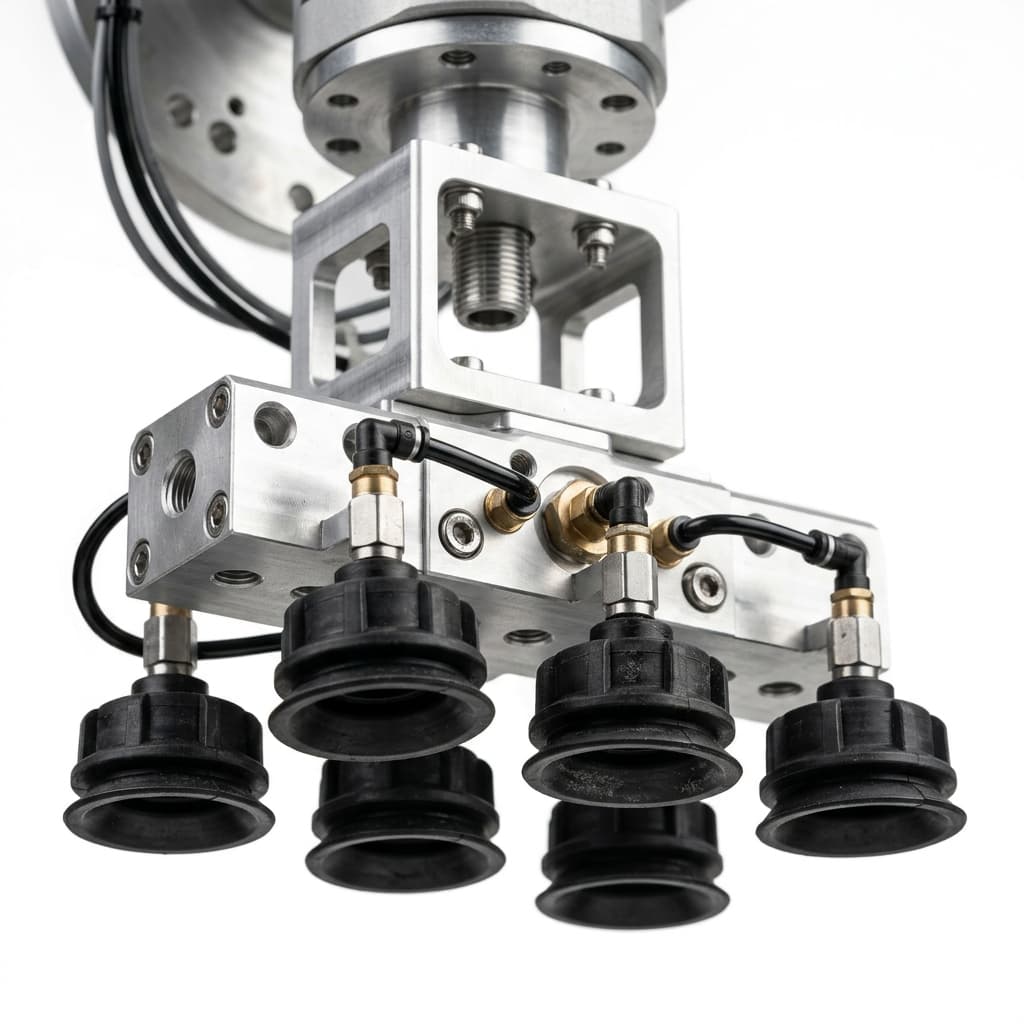
304 stainless steel EOAT vacuum manifold
Start with the payload calculator, then review washdown, thread galling, and internal channel cleanability limits to determine if 304 stainless is the right material for your robotic vacuum manifold.
Reviewed July 24, 2026
Vacuum Manifold Payload Calculator
Estimate the mass of a 304 SS manifold block. The calculator accounts for material removed by internal vacuum channels to give you a realistic payload margin check.
Key Takeaways
- Payload Impact: 304 SS is much heavier than aluminum, so even a compact manifold block can consume a large share of payload once fittings, cups, valves, and sensors are included.
- Washdown Suitability: 304 can be a good fit for wipedown or mild washdown cells, but chemistry matters. Repeated chloride, bleach, brine, or warm crevice exposure should trigger a 316L review.
- Thread Galling in Vacuum Lines: Fasteners and pneumatic fittings can seize in 304 SS ports. Specify fitting material, thread tolerance, torque, assembly speed, and any lubricant or coating only after confirming process compatibility.
- Internal Cleanability: Exterior finish targets do not prove that intersecting cross-drilled vacuum channels are cleanable. Design for flushability, drainability, and verifiable plugged-hole inspection.
- Machining Complexity: Deep holes, intersecting ports, and tapped plugs in austenitic stainless need planned fixturing, chip evacuation, coolant strategy, and inspection access before quote approval.
Method: From Payload Screen to RFQ Package
Use the calculator as the first gate, then connect the result to cleanability, thread risk, and inspection scope before selecting 304 stainless for the manifold.
1. Screen payload mass
Use the calculator to verify the cobot/robot payload margin using a 304 SS block minus estimated channel volume.
Must include the weight of fittings, vacuum cups, and valves mounted directly to the manifold.
2. Check internal cleanability
If washdown is required, ensure all vacuum channels can be flushed, drained, and lack dead-legs.
304 SS resists corrosion but trapped debris or cleaning fluid in deep cross-holes will harbor bacteria regardless of material.
3. Quote thread requirements
Specify thread types (NPT, G, BSPP) and call out anti-seize or dissimilar metals to prevent thread galling.
Threading 304 SS is prone to galling. Proper tolerances and assembly procedures are mandatory.
4. Package the RFQ evidence
Send CAD, port maps, payload budget, cleaning chemistry, finish targets, and inspection requirements together.
This lets the supplier quote machining, leak test, passivation, and inspection as one controlled scope.
Need a Payload and Washdown Review?
Send the CAD, port map, robot payload limit, and cleaning chemistry together so machining risk, material suitability, and inspection scope can be reviewed as one manifold package.
Design & Sourcing Decisions
Use this decision matrix to justify 304 stainless over aluminum or 316L based on your operating environment and sanitary requirements.
| Environment | Recommendation | Why |
|---|---|---|
| Dry packaging, carton erecting, general pick-and-place | AL6061-T6 | Lighter, cheaper, and faster to machine. No need for the heavy mass and cost of 304 SS. |
| Wipedown or mild washdown environment | 304 stainless steel | Provides necessary corrosion resistance against water and mild detergents without the premium of 316L. |
| Harsh chemicals, chlorides, meat/dairy processing washdown | 316L stainless steel | 316L provides superior pitting resistance against chlorides commonly used in aggressive sanitary cleaning. |
Engineering Evidence & Boundaries
Data points and regulatory boundaries to consider when specifying 304 stainless for a robotic vacuum manifold. Source links were reviewed on July 24, 2026.
| Criteria | Value | Boundary / Limit | Source |
|---|---|---|---|
| 304 stainless density screening basis | The calculator uses 8.0 g/cm3 as a conservative early payload-screening assumption. | Use this as an early mass estimate; ask the supplier to confirm exact CAD mass after channeling. | AZoM: Stainless Steel 304 material data |
| 6061 aluminum density comparison | 6061 aluminum is commonly estimated near 2.70 g/cm3, so equal envelopes can diverge sharply on payload. | Density does not settle cleanability, corrosion, or galling risk; compare it alongside washdown and inspection needs. | AZoM: Aluminium 6061 material data |
| Food contact equipment expectations | 21 CFR 117.40 is performance-based: cleanable, corrosion-resistant, nontoxic | Regulatory text does not approve a specific manifold design; it sets cleanability and maintenance expectations. | eCFR: 21 CFR 117.40 Equipment and utensils |
| Internal channel surface finish and fluid flow | Ra 0.8 um / 32 uin target for hygienic surfaces | Blind holes and intersecting vacuum channels in 304 SS are difficult to electropolish or inspect. Design for flow-through cleaning. | 3-A Sanitary Standards |
| Chloride and chemical pitting | 304 stainless can pit in chloride, bleach, warm, or crevice-prone conditions | Do not treat 304 as a universal sanitary alloy; document chemical concentration, temperature, and exposure time. | BSSA: stainless selection for sodium hypochlorite exposure |
| Austenitic stainless machining behavior | Austenitic stainless steels work-harden, so chip control, coolant, insert grade, and stable fixturing need planning. | Final feeds and speeds depend on bore depth, coolant pressure, drill geometry, and the shop fixture strategy. | Sandvik Coromant: Stainless steel workpiece materials |
| Stainless thread galling | Stainless threaded joints can seize; lubricant, mating material, speed control, and fit selection reduce risk. | For vacuum circuits, confirm lubricant and fitting compatibility instead of assuming general anti-seize is acceptable. | ASSDA: Galling and its control |
Risks and Mitigations
| Risk | Impact | Mitigation |
|---|---|---|
| Payload Exceedance | Robot servo faults or reduced cycle times | 304 SS is heavy. A manifold block can consume a large share of a smaller robot payload once fittings, cups, valves, and sensors are included. Maximize internal pocketing and verify total tool mass before ordering. |
| Thread Galling in Vacuum Ports | Fittings seize permanently in the manifold ports during assembly | Avoid dry stainless-on-stainless assembly where possible. Define fitting material, torque, assembly speed, and any lubricant or coating only after confirming vacuum and product-zone compatibility. |
| Dead-Legs and Trapped Contaminants | Bacterial growth in un-drainable cross-drilled channels | Design channels to be flushable and drainable. Avoid blind holes, call out sanitary plugs where cross-drilling is necessary, and verify internal cleanability instead of relying only on exterior finish. |
Frequently Asked Questions
Why is a 304 stainless steel vacuum manifold so heavy?
304 stainless steel is commonly estimated near 8 g/cm3, while 6061 aluminum is commonly estimated near 2.7 g/cm3. A manifold with the same envelope can therefore add several kilograms before ports, plugs, sensors, and fittings are counted.
How do you machine internal vacuum channels in 304 SS?
Channels are often cross-drilled from the sides of the manifold block, then tapped and plugged where needed. Because 304 SS work-hardens, the quote should account for stable fixturing, chip evacuation, coolant strategy, port access, and inspection of plugged intersections.
How do I prevent thread galling on vacuum ports without contaminating the vacuum?
Avoid dry stainless-on-stainless assembly where possible. Define fitting material, thread tolerance, torque, assembly speed, and any lubricant or coating only after confirming vacuum and product-zone compatibility.
Can the internal channels be electropolished?
Do not assume electropolishing solves internal cross-drilled passages. Specify the internal cleanability requirement, avoid dead-legs, define how plugged holes are verified, and ask the supplier what finish can be inspected inside the channel geometry.
Is 304 SS suitable for all food applications?
No. 304 SS is widely used, but suitability depends on cleaning chemistry, chloride exposure, temperature, dwell time, rinse practice, and customer standards. 316L should be considered when chloride or aggressive sanitation exposure rises.
When should 316L be considered instead of 304?
Consider 316L when the manifold will see recurring chloride washdown, aggressive sanitation chemistry, or customer standards that explicitly call for higher molybdenum stainless. The chemistry, concentration, temperature, and dwell time should drive the decision.
When is aluminum still a better EOAT manifold choice?
Aluminum remains attractive when payload, acceleration, and cycle time dominate and the process does not need stainless corrosion resistance or sanitary documentation. Add coatings or wear inserts only after checking the product-zone requirements.
What channel reduction should I enter in the calculator?
Use a conservative estimate before CAD: 10-20% for simple cross-drilled circuits, higher only if the design has verified pockets, pockets are cleanable, and wall thickness remains adequate around ports and plugs.
Can the calculator replace a CAD mass property check?
No. It is a screening tool. CAD mass properties, fitting mass, plug mass, sensors, and the complete EOAT stack should be verified before approving payload margin or cycle acceleration.
Which port details should be sent for quoting?
Send thread standard, port count, port depth, seal style, fitting material, orientation constraints, required plugging method, and whether any ports are in product-contact or washdown zones.
What inspection evidence should be requested?
For a stainless EOAT vacuum manifold, common RFQ evidence includes material certification, dimensional inspection, leak-test criteria, passivation record when required, and proof that plugged or cross-drilled features were verified.
What if the washdown chemistry is not known yet?
Treat the material selection as provisional. Document the unknown, avoid claiming sanitary suitability, and ask the end user for sanitizer type, concentration, temperature, dwell time, and rinse practice before locking 304.
Related Resources
304 vacuum end effector plate checker
Check plate mass and axial cup force separately, then prepare sealing and inspection requirements.
Vacuum manifold product family
Review custom vacuum manifold and suction cup mount machining options for EOAT assemblies.
304 stainless EOAT bracket
Use this guide for structural plates and mounts that do not require internal vacuum routing.
304 stainless EOAT adapter plate
Compare adapter plate mass, tolerance, and corrosion tradeoffs against manifold requirements.
CNC machining materials matrix
Compare 304, 316L, and AL6061-T6 to verify if a stainless manifold is strictly necessary.
Quality and inspection workflow
Plan material certification, dimensional inspection, leak-test evidence, and shipment records.
RFQ-Ready Next Step for a 304 Stainless Manifold
If the payload screen still looks workable, send the manifold as a complete sourcing package instead of a material request only.
- Native CAD or STEP model, drawing, envelope limits, and robot-side mounting datum.
- Vacuum port map, internal-channel concept, fitting/thread standard, and preferred seal method.
- Robot model, rated payload, known acceleration limits, gripper stack mass, and allowable manifold mass target.
- Washdown chemistry, chloride exposure, temperature range, finish target, and passivation or electropolish expectation.
- Inspection package: material certificate, first-article report, leak-test target, plugged-cross-hole proof, and serialization needs.
Inquiry Email
Attach your CAD files (STEP, IGES) and tolerances for quick quoting.