
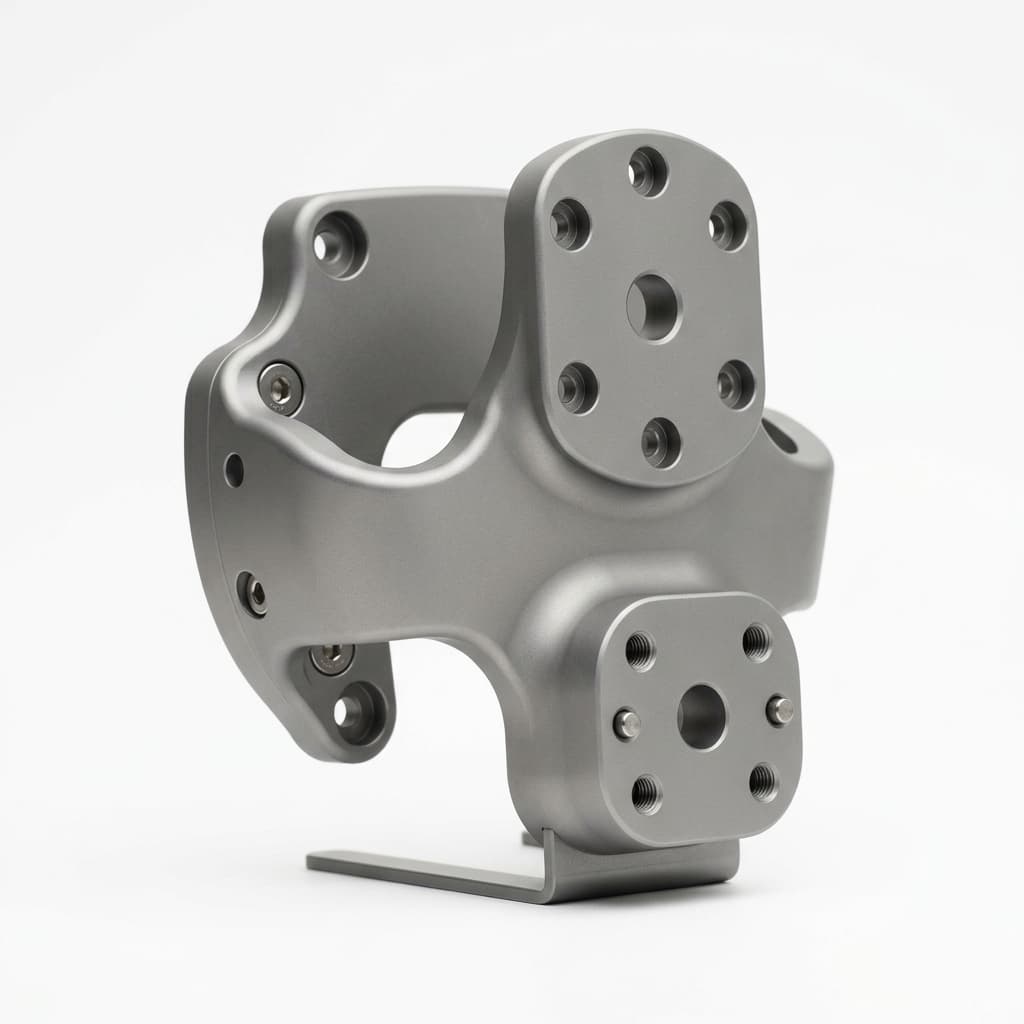
304 stainless steel EOAT bracket
Start with the payload calculator, then use the EOAT interface checks to decide whether 304 stainless, 316L, or AL6061 is the safer bracket material choice for a robot wrist, tool changer, gripper, or vacuum frame.
Reviewed July 18, 2026
Inquiry Email
Attach your CAD files (STEP, IGES) and tolerances for quick quoting.
Payload Weight Calculator
Start with dimensions, robot payload, and other EOAT mass. The result explains whether a 304 stainless bracket is payload-safe, tight, or overloaded before you invest in a quote.
Key Takeaways
- Weight Penalty: 304 SS is roughly 3x heavier than AL6061-T6. A standard 150x150x15mm bracket blank weighs ~2.7kg in 304 SS, consuming over 50% of a 5kg cobot payload.
- Hygiene & Compliance: Essential for food-grade and pharmaceutical environments when the customer specification calls for corrosion resistance, washdown durability, passivation, and a hygienic surface finish such as Ra 0.8 um / 32 uin.
- Machining Costs: 304 SS is tougher and work-hardens, so quoting should expect lower cutting speeds, stronger fixturing, sharper tooling, coolant control, and more inspection time than a comparable aluminum bracket.
- Food-Zone Boundaries: 304 is a common stainless choice, but FDA 21 CFR 117.40 is performance-based. The drawing still needs cleanability, corrosion resistance, finish, passivation, and inspection notes that match the actual product zone and cleaning chemistry.
- Sensor Boundary: annealed 304 is generally treated as non-magnetic, but machined or cold-worked surfaces can show weak magnetic pull. Keep magnetic sensors, reed switches, and ferrous debris controls in the EOAT risk review.
- Decision Rule: choose 304 when washdown or customer material rules are mandatory, choose 316L when chlorides are credible, and choose AL6061-T6 when payload margin is the controlling requirement.
How to Decide Before Quoting
Treat the calculator as the first screen, not the final engineering release. A 304 stainless steel EOAT bracket is usually justified by environment and customer specification, then checked against robot payload and machining cost.
| Method Step | What to Check | Decision Boundary |
|---|---|---|
| 1. Screen mass | Use the calculator to compare a rectangular 304 stainless blank against AL6061-T6. | The number excludes pockets, counterbores, inserts, dowels, fasteners, and tool-changer hardware. |
| 2. Check exposure | Classify the line as dry, splash, washdown, chloride-heavy, or cleanroom before choosing 304. | Strong bleach, brine, high-salt food, marine exposure, and warm crevices can push the design toward 316L. |
| 3. Quote manufacturability | Call out surface finish, passivation/electropolish, tolerance datum scheme, and inspection evidence. | A generic stainless note is not enough for sanitary or repeatable robot interface work. |
304 Stainless Steel vs AL6061-T6
While 304 stainless steel offers superior corrosion resistance and hygiene, its weight and machinability often push engineers toward AL6061-T6 for general automation. If your application involves chloride exposure, consider viewing our 316 Stainless Steel EOAT Bracket guide instead.
| Property | 304 Stainless Steel | AL6061-T6 |
|---|---|---|
| Density | 8.00 g/cm³ | 2.70 g/cm³ |
| Tensile Strength | Typical published value around 500 MPa; verify by product form, heat, and material certificate | Typical T6 published value around 310 MPa; verify temper, supplier, and drawing allowable |
| Corrosion Resistance | Strong general corrosion resistance; confirm 316L for chloride-heavy washdown | Good (Anodizing recommended) |
| Machining Speed and Tool Wear | Lower speeds, sharper tools, and coolant control are usually required because 304 can work-harden during cutting | Usually faster to machine for comparable bracket geometry; confirm exact SFM and cycle time with toolmaker data |
| Machinability | Moderate; avoid rubbing cuts and poor chip evacuation | Excellent |
| Best Used For | Washdown environments, cleanrooms, and customer stainless material requirements | Standard payload-sensitive robot tooling |
Material Choice by Use Condition
This page targets 304 stainless steel, but a good sourcing decision must also say when not to use it. Use this table to keep the primary keyword intent aligned with practical EOAT material selection.
| Use Condition | Recommended Baseline | Why It Fits |
|---|---|---|
| Dry or lightly wiped general automation | AL6061-T6 or hard-anodized aluminum | Usually gives the best payload margin, machining speed, and cost for non-washdown brackets. |
| Routine water washdown, mild cleaners, stainless customer spec | 304 stainless steel | Useful when corrosion resistance and cleaning durability matter more than the weight penalty. |
| Chlorides, strong bleach, brine, warm crevices, or marine exposure | 316L stainless steel | Molybdenum-bearing 316L is the safer baseline when chloride pitting or crevice corrosion is credible, but final approval still depends on the actual chemistry and dwell time. |
| Small cobot or high-acceleration pick cycle | Pocketed 304 only if stainless is mandatory | Mass can consume payload and reduce acceleration; verify final CAD mass and robot derating. |
| Food-zone EOAT or FDA/GMP inspected line | 304 or 316L SS + specified finish + passivation/cleanability review | 21 CFR 117.40 sets performance requirements for cleanable, corrosion-resistant, nontoxic surfaces; the drawing still needs the exact material, Ra target, passivation, and inspection notes. |
EOAT Interface Checks Before Releasing 304
The EOAT-specific decision is not just material grade. A stainless bracket can solve washdown or customer-material requirements while creating payload, routing, magnetic-sensor, and service-access problems at the robot wrist.
| EOAT Area | Decision Question | RFQ Impact |
|---|---|---|
| Robot wrist and tool-changer interface | Does the 304 bracket keep the robot flange, tool changer, dowel scheme, and service clearance repeatable after cleaning? | Needs bolt-circle data, datum references, stack height limits, and fastener access from both sides. |
| Vacuum, pneumatic, and cable routing | Will stainless mass crowd tubing, valve islands, vacuum cups, or dress-pack exits on a compact EOAT frame? | Needs routing keep-outs, ports, sensor brackets, cable bend radius, and drain/cleaning access. |
| Magnetic sensors and part-present checks | Could cold-worked or machined 304 create enough magnetic response to disturb reed switches, proximity sensors, or ferrous debris control? | Needs sensor locations, required permeability if any, and a mitigation path such as AL6061 or sensor spacing. |
| Washdown and product-zone exposure | Is the bracket only near the EOAT frame, or does it sit in the product splash/contact zone? | Needs chemical list, chloride/bleach exposure, surface finish, edge break, passivation, and cleaning validation notes. |
Design Risks & Mitigation
Risk: Overloading the Robot
Specifying a 304 SS bracket purely for strength can consume the entire allowable payload of smaller robots, leading to servo faults or reduced acceleration.
Mitigation: Pocketing & FEA
If 304 SS is strictly required for hygiene, use pocketing (removing non-structural material) where the load path allows it. Verify final mass, stiffness, and robot dynamics from CAD and FEA before release.
| Risk | Decision Impact | Mitigation |
|---|---|---|
| Payload overrun | Servo faults, reduced acceleration, or forced robot upsizing | Run the calculator first, then verify final CAD mass with fasteners and tool-changer hardware included. |
| Wrong stainless grade | Pitting or staining in chloride-heavy washdown | Document chemicals, concentration, temperature, dwell time, and crevice exposure before approving 304. |
| Unquoted finish work | Supplier variance, late cost changes, or failed hygiene review | Put Ra target, edge break, passivation/electropolish, and inspection method directly on the drawing. |
| Interface stack-up | Robot flange, tool changer, dowels, or gripper pattern fails to align | Provide robot model, bolt circle, dowel scheme, datum references, and any customer interface standard. |
| Magnetic interference | Sensor false triggers or ferrous particle attraction to the EOAT | Heavy CNC machining induces weak ferromagnetism (martensite) in 304. Route sensors away or use AL6061-T6. |
| Thread Galling (Cold Welding) | Fasteners seize permanently in tapped holes, destroying the bracket and tooling during assembly | Call out anti-seize paste on the drawing, or specify dissimilar fastener alloys (like 316 SS or A4 hardware). Avoid power tool installation. |
Evidence, Standards & Application Boundaries
Evidence reviewed July 18, 2026. Public material data and standards guidance are useful for screening, but the buyer's robot model, plant chemicals, drawing notes, and quality plan decide the final material and finish.
Sanitary Design Compliance
FDA 21 CFR 117.40 describes cleanability, corrosion resistance, nontoxic food-contact surfaces, and suitability for cleaning conditions; it does not approve a bare alloy by name. 3-A and customer hygienic-design requirements often define the measurable Ra target, radii, drainability, passivation, and inspection method that belong on the drawing.
The Chloride Boundary
304 SS can pit in chloride-heavy environments, especially with crevices, heat, long dwell time, or aggressive sanitizers. If the line sees strong bleach, brine, marine exposure, or high-salt foods, price 316L as the safer baseline.
| Claim Used | Screening Value | Traceable Source Type | Boundary |
|---|---|---|---|
| 304 stainless density used by the calculator | 8.0 g/cm3 | AZoM: Stainless Steel 304 material data | Use final CAD mass properties when the bracket has pockets, counterbores, dowel holes, or inserts. |
| AL6061-T6 density used by the calculator | 2.7 g/cm3 | AZoM: Aluminium / Aluminum 6061 alloy data | Use the actual alloy temper and any coating or hard-anodize thickness for final weight review. |
| Strength comparison is a screening value only | 304 and AL6061-T6 strength values vary by form, temper, and supplier | AZoM material data for 304 stainless and 6061 aluminum | Do not use a web table as the design allowable; use mill certificates, drawing requirements, and engineering review. |
| Sanitary surface finish target | Ra 0.8 um / 32 uin is a common hygienic-design target | 3-A Sanitary Standards primer on surface finish criteria | Treat as an RFQ requirement to confirm, not a universal certification guarantee. |
| Chloride exposure boundary | 304 stainless can pit in chloride, bleach, warm, or crevice-prone washdown conditions | BSSA: stainless selection for chlorine exposure | Do not apply a universal ppm cutoff; document cleaner chemistry, concentration, temperature, dwell time, and crevices before approving 304 or pricing 316L. |
| Machining penalty versus aluminum | 304 stainless generally needs lower surface speed, sharper tooling, coolant control, and work-hardening avoidance than AL6061-T6 | Sandvik Coromant stainless steel milling application guidance | Use toolmaker data, feature depth, rigidity, coolant, tolerance, and finish requirements for exact SFM, tool life, and cycle-time quoting. |
| FDA food-contact equipment rule | 21 CFR 117.40 is performance-based: cleanable, corrosion-resistant, nontoxic, and suited to the use environment | eCFR: 21 CFR 117.40 Equipment and utensils | This is not a 304-specific FDA approval or GRAS listing; final acceptance depends on food zone, chemistry, finish, cleanability, and plant quality review. |
| Chemical passivation standard | ASTM A967/A967M-25 covers nitric acid, citric acid, and electrochemical passivation treatments | ASTM International A967/A967M-25 | The standard includes alternative effectiveness tests and does not prove material grade, application suitability, or reverse machining-induced magnetism. |
| Magnetic response after machining or cold work | Cold-worked austenitic stainless steels can show magnetic pull at machined surfaces or sharp edges | BSSA: magnetic permeability of austenitic stainless steels | A magnet check is not a grade-verification method; specify MTR, PMI, or magnetic permeability requirements when sensors are sensitive. |
| Thread galling (cold welding) risk | 304 fasteners threading into a 304 bracket have a high risk of fusing under friction | Velocity Bolting: thread galling prevention overview | Specify anti-seize lubricants, use dissimilar alloys (e.g., 316 bolts with 304 bracket), and avoid high-speed power tools. |
RFQ Inputs That Change the Quote
A useful RFQ for a 304 stainless steel EOAT bracket should include the checks below. Without them, the quote usually hides risk in assumptions about mass, finish, and interface fit.
Need a drawing review before quoting? Send the CAD model, payload estimate, robot flange pattern, and washdown notes together.
Send bracket RFQRobot model and payload
Payload margin and bolt pattern compatibility
CAD model or drawing
Pocketing, hole features, tolerances, and final mass
Washdown chemicals
Whether 304 is acceptable or 316L is safer
Surface finish target
General machined finish versus hygienic polish/electropolish
Interface standard
Robot flange, tool changer, dowel pattern, and fastener class
Adjacent Engineering Context
Keep this page focused on 304 stainless steel EOAT brackets, then use the adjacent pages when the buyer needs material-wide, process-wide, or end-effector terminology support.
CNC machining materials matrix
Compare 304, 316L, AL6061-T6, AL7075-T6, titanium, and engineering plastics before locking the bracket alloy.
304 stainless EOAT vacuum manifold
If your bracket assembly includes vacuum routing, review the payload and washdown limits for 304 SS manifolds.
EOAT machining capabilities
Review the machining routes, datum controls, inspection evidence, and lightweighting options that affect a stainless EOAT quote.
304 stainless end effector adapter plate
Use the adjacent end-effector page when the buyer says end effector instead of EOAT, or when the interface scope is broader than the EOAT wrist plate.
304 stainless EOAT mounting plate
Use this when bracket loads resolve into a shared wrist or tool-changer mounting plane with dowels, services, and washdown geometry.
Sensor brackets and cobot mounts
See related bracket-style EOAT parts with counterbores, slots, and compact robot-side mounting features.
Tool changer adapter plates
Review adapter hardware when the 304 stainless bracket connects through a robot tool changer stack.
Frequently Asked Questions
When is 304 stainless worth the payload penalty?
Use 304 when washdown durability, corrosion resistance, customer material rules, or cleanability are stronger requirements than cycle-time acceleration and low mass.
When should I choose 316L instead?
Choose 316L for chloride-heavy cleaners, brine, high-salt foods, marine exposure, warm crevices, or customer specs that explicitly require molybdenum-bearing stainless.
Can aluminum still pass a food or medical automation review?
Sometimes, but it depends on the customer standard, coating, wear exposure, cleaning chemistry, and whether the plate contacts the product zone. Do not assume anodized aluminum is acceptable without the drawing note and compliance review.
Does 304 stainless require passivation?
For general automation it may not be required, but passivation is often requested for cleanroom, food, pharmaceutical, or corrosion-sensitive programs. Put the requirement and acceptance method in the RFQ.
How accurate is the calculator?
It is a screening estimate for a rectangular blank. Final mass must come from CAD after pockets, holes, counterbores, inserts, dowels, fasteners, and purchased tooling are included.
What tolerances should a 304 EOAT bracket use?
Use the robot flange, dowel, tool changer, and gripper interface as the tolerance drivers. Avoid blanket tight tolerances; call out datum-controlled features where repeatability matters.
What makes 304 more expensive to machine than aluminum?
304 work-hardens and usually needs more controlled cutting, coolant, chip evacuation, and inspection time than AL6061-T6 on comparable geometry.
Can a 304 EOAT bracket be lightweighted?
Yes. Use pockets, relief cuts, scallops, and rib-like sections after the robot interface, dowels, tapped holes, and gripper loads are fixed. Keep enough stock around fasteners and datum features for stiffness and inspection repeatability.
What surface finish should I specify for washdown use?
Specify the required Ra target, edge break, deburr standard, passivation or electropolish requirement, and any crevice limits. For food or medical programs, align the note with the customer standard before quoting.
What should I send for an RFQ?
Send 3D CAD, 2D drawing, robot model, payload, other EOAT mass, washdown chemicals, surface finish target, passivation/electropolish notes, and interface hardware requirements.
Is 304 stainless steel magnetic after machining?
Yes, it can be. While annealed 304 is non-magnetic, heavy CNC machining (cold working) triggers a microstructural shift to martensite, making the surface weakly magnetic. If your EOAT has sensitive magnetic sensors, verify placement distance or switch materials.
Why do bolts get stuck in 304 stainless steel brackets?
This is called thread galling or cold welding. Because 304 SS relies on an oxide layer, friction from tightening breaks this layer, fusing the same-grade metals together. Always use anti-seize lubricant, slow hand-tightening, or dissimilar alloys (like 316 bolts) to prevent this.
Ready to Manufacture Your Bracket?
Send us your 3D CAD models. We will review material choices, payload considerations, and provide a DFM-optimized quote.
Inquiry Email
Attach your CAD files (STEP, IGES) and tolerances for quick quoting.