
How to Choose the Right Material for Robotic Grippers: Aluminum vs. Stainless Steel vs. Plastics
A practical engineering guide for selecting the optimal CNC material for your robotic grippers and end effectors to maximize payload and minimize fatigue.
The performance of an automated robotic cell is entirely bottlenecked by its weakest link. More often than not, that weak link is the End-of-Arm Tooling (EOAT). If your gripper fingers deflect under load, wear out prematurely, or weigh too much, the robot's overall kinematic efficiency plummets.
TL;DR (Executive Summary): To maximize payload and minimize inertia, many EOAT bodies start with AL6061-T6. Consider AL7075-T6 for thin, high-stress linkages when deflection is a risk. Cap contact points with hardened steel for abrasion resistance or POM (Delrin) / urethane for non-marring handling.
Selecting the exact alloy for your EOAT components comes down to trading off mass against fatigue limits. Here is the raw data on the most common CNC materials used in industrial automation.
Quick Reference: Material Properties for EOAT
Skip the guesswork. Here is the mechanical baseline for materials commonly used in machined robot grippers. Treat these as starting points for engineering review, not replacements for your own load calculations or regulated-industry validation.
| Material Grade | Density (g/cm³) | Yield Strength (MPa) | Hardness | Best Use Case |
|---|---|---|---|---|
| AL 6061-T6 | 2.70 | 276 | 95 HB | Main structural bodies, manifolds |
| AL 7075-T6 | 2.81 | 503 | 150 HB | High-speed linkage arms |
| SUS 316L | 7.99 | 170 | 80 HRB | Washdown/Corrosive environments |
| SUS 440C | 7.80 | 1900* (*Heat treated) | 58-60 HRC | High-wear gripper jaws |
| Delrin (POM) | 1.41 | 60 | M90 (Rockwell) | Non-marring contact pads |
Application Matrix: What Should You Specify First?
The right material is rarely a single-material answer. Most reliable EOAT assemblies mix a lightweight structural body with harder or softer contact inserts.
| Application | Structural Body | Contact Surface | Avoid | Reason |
|---|---|---|---|---|
| High-speed pick and place | AL6061-T6 or AL7075-T6 | POM or urethane pads | Full stainless body | Keeps inertia low and protects robot payload |
| Abrasive metal parts | AL7075-T6 carrier | 440C hardened steel inserts | Soft aluminum jaws | Contact faces need wear resistance |
| Food washdown | 316L stainless or hard-anodized aluminum if allowed | 316L / approved polymer | Unsealed porous materials | Cleaning chemicals and hygiene rules drive material choice |
| Medical packaging | 316L, PEEK, or cleanroom-compatible aluminum | PEEK / POM where allowed | Unknown additives or coatings | Traceability and cleanability matter |
| Semiconductor / wafer handling | PEEK, POM, anodized aluminum | PEEK / ESD-safe polymer | Outgassing or particle-shedding materials | Low contamination risk is more important than raw strength |
| Painted or polished consumer parts | AL6061 body | POM, UHMW, or urethane pads | Bare steel contact faces | Prevents scratches and visible handling marks |
| Heavy castings or forgings | AL7075 or steel carrier | Hardened steel inserts | Plastic-only jaws | Shock and wear dominate the design |
Payload Penalty: Why Material Density Changes Robot Speed
For a simple 200 x 120 x 25mm gripper body, material choice can change the mass dramatically before you add cylinders, cups, sensors, or brackets.
| Material | Approx. Density | Approx. Body Mass for 600 cm³ | Practical Meaning |
|---|---|---|---|
| POM / Delrin | 1.41 g/cm³ | 0.85 kg | Very light, but lower stiffness and temperature limits |
| AL6061-T6 | 2.70 g/cm³ | 1.62 kg | Strong default for most EOAT bodies |
| AL7075-T6 | 2.81 g/cm³ | 1.69 kg | Similar weight to 6061, much stronger for thin features |
| 316L stainless | 7.99 g/cm³ | 4.79 kg | Excellent for washdown, costly for robot payload |
This is why a "stronger" material can make the cell worse. If a 10kg payload cobot carries a 4.8kg stainless EOAT, nearly half the payload is gone before the robot picks the actual part. In many cases, an AL7075 body with replaceable hardened steel jaw inserts gives better total system performance.
1. Aluminum Alloys (The Industry Standard)
Aluminum is by far the most dominant material used in custom EOAT manufacturing. It strikes the perfect balance for industrial robotics: it’s lightweight, highly machinable, and exceptionally strong when alloyed.
AL 6061-T6
- Best For: General-purpose gripper bodies, structural adapter plates, and pneumatic manifolds.
- Why it works: AL6061 offers excellent corrosion resistance and accepts surface treatments (like Type II and Type III Hard Coat anodizing) beautifully. It's the default choice for 80% of automation components because it won't eat into the robot's payload capacity while maintaining rigid structural integrity. It is also highly economical to machine.
AL 7075-T6 (Aerospace Grade)
- Best For: High-stress linkage arms, slim gripper fingers, and high-speed moving parts.
- Why it works: AL7075 boasts a tensile strength nearly double that of AL6061—rivalling some mild steels—but at a fraction of the weight. When your robot requires ultra-fast acceleration (high G-forces) and minimal inertia, AL7075 is the premium choice to prevent deflection in extended gripper fingers.
2. Stainless Steel (The Heavy-Duty Defender)
While aluminum excels at being lightweight, it is relatively soft. When the EOAT needs to physically interact with abrasive environments, handle extreme impacts, or withstand harsh chemical washdowns, stainless steel steps in.
SUS 304 / 316L (Austenitic)
- Best For: Food-grade automation, medical packaging, and corrosive washdown environments.
- Why it works: Austenitic stainless steels are highly corrosion-resistant and non-magnetic. If your EOAT operates in a food-safe facility where it gets blasted with caustic cleaning agents (like sodium hydroxide) daily, 316L is mandatory. Note: It is heavy, so it should only be used where necessary to avoid payload penalties.
SUS 420 / 440C (Martensitic / Hardened)
- Best For: Gripper jaw contact faces, locating pins, and wear pads.
- Why it works: These martensitic stainless steels can be heat-treated to high Rockwell hardness (HRC 58-60). If your robot repeatedly grips unmachined castings, rough forgings, or glass, hardened stainless jaws give the contact surface a better chance of surviving high-cycle wear without losing the intended grip profile.
3. Engineering Plastics (The Gentle Touch)
Sometimes, metal is too harsh. When handling delicate, scratch-sensitive, or statically sensitive parts, CNC machined polymers are required.
POM (Delrin / Acetal)
- Best For: Suction cup mounts, electrical isolation blocks, and non-marring gripper fingers.
- Why it works: Delrin is highly machinable, dimensionally stable (it absorbs very little moisture), and has a very low coefficient of friction. If you are handling polished acrylic lenses, PCBs, or painted automotive trim, Delrin jaws provide firm clamping without scratching the payload.
PEEK (Polyether Ether Ketone)
- Best For: High-temperature environments, semiconductor handling, and vacuum chambers.
- Why it works: PEEK is an advanced, ultra-high-performance thermoplastic. It maintains its mechanical properties at temperatures exceeding 250°C (480°F) and resists harsh chemical solvents. It is frequently used in wafer-handling EOAT inside semiconductor fabrication plants. Due to its high material cost, it is usually reserved for extreme environments.
Material + Surface Treatment Compatibility
Surface treatment should be specified by function: corrosion protection, wear resistance, cleanability, color coding, or low friction. Do not apply every finish to every face.
| Base Material | Common Treatment | Good For | Watch Out For |
|---|---|---|---|
| AL6061-T6 | Type II anodize | General corrosion protection and color coding | Mask tight dowel holes and threaded inserts if fit matters |
| AL6061 / AL7075 | Type III hardcoat anodize | Wear surfaces, sliding interfaces, abrasive environments | Adds coating thickness; define whether dimensions apply before or after coating |
| 316L stainless | Passivation | Food, medical, and washdown environments | Does not fix poor surface finish or trapped crevices |
| 440C stainless | Heat treat + grind critical faces | Hardened jaw inserts and wear pads | Heat treatment can distort thin parts; finish grind may be needed |
| POM / Delrin | Usually no coating | Low-friction, non-marring contact pads | Not suitable for high heat or aggressive solvents |
| PEEK | Usually no coating | High temperature, semiconductor, chemical resistance | Expensive; use only where the environment justifies it |
Multi-Material EOAT Stack-Up
A high-performing gripper is usually not one material. It is a stack-up: lightweight body, stronger arms, hardened or soft contact inserts, and precise locating hardware.
Field note from material reviews: Stainless steel can be the right choice for washdown or abrasive contact, but it can quickly consume a cobot payload budget. For many EOAT assemblies, a lighter aluminum carrier plus localized steel inserts gives a better payload-to-wear trade-off.
Summary: Designing for the Payload (The Golden Rule)
Every gram of weight you add to the end effector is a gram subtracted from the robot's maximum payload and a marginal decrease in acceleration speed.
The Golden Rule of EOAT Material Selection:
"Build the massive structural body from anodized AL6061 to save weight and cost. Use AL7075 for thin, load-bearing linkages where deflection is a risk. Cap the actual contact points (the jaws/fingers) with Hardened Steel for abrasive wear resistance, or Delrin to protect delicate payloads."
Visualizing The Golden Rule of EOAT Design
Actionable RFQ Checklist for Custom EOAT
When sending your 3D CAD files to a machining partner, ensure your 2D PDF drawings specify:
- Exact Material Alloy: Don't just write "Aluminum". Specify "AL6061-T6" or "AL7075-T651".
- Hardness Requirements: For steel jaws, specify the heat treatment target (e.g., "Harden to HRC 58-60").
- Surface Treatment: Clearly label faces that require hard-coat anodizing, electroless nickel plating, or PTFE impregnation.
- Cleanroom Prep: If applicable, state "No silicone-based cutting fluids" or "Ultrasonic clean before vacuum packaging".
Copy-Paste Material Specifications for RFQs
Use these as starting language for your 2D drawing or RFQ email, then adjust them to your company's standards.
| Situation | Example Specification |
|---|---|
| General aluminum EOAT body | Material: AL6061-T6. Finish: clear Type II anodize. General tolerance ISO 2768-m unless noted. |
| Lightweight high-stress gripper arm | Material: AL7075-T651. Critical flatness 0.03mm on datum A. Black Type III hardcoat anodize after machining. |
| Hardened steel jaw insert | Material: SUS 440C. Heat treat to HRC 58-60. Grind contact face after heat treatment. |
| Food washdown bracket | Material: SUS 316L. Passivate after machining. Avoid blind crevices and sharp internal corners. |
| Non-marring contact pad | Material: POM-C black or natural. Deburr all edges. No coating. Confirm part-contact face Ra requirement. |
| Semiconductor / high-temperature insert | Material: PEEK. Confirm grade and certificate. Ultrasonic clean and bag before shipment if required. |
(Want to lower your quotes even further? Read our 5 DFM Tips for Custom CNC Grippers).
By combining materials effectively, you can design an end effector that improves payload use, reduces unnecessary inertia, and gives maintenance teams clearer replacement-part rules.
Need help manufacturing your multi-material gripper assembly? Contact the EOAT Machining engineering team to discuss your material requirements, surface treatments, and CAD models.
Author

Categories
More Posts
Custom CNC Machining for AI Vision-Guided EOAT: Calibration Stability and Procurement Guide
Prevent hand-eye calibration drift in vision-guided EOAT with CNC machined camera mounts, DFM rules, tolerance notes, and an RFQ checklist.
Robotic Automatic Tool Changers (ATC): Machining Tolerances and Procurement Specs for EOAT
Specify robotic Automatic Tool Changers for EOAT machining: repeatability, fail-safe locks, utility ports, payload moments, and supplier QA checks.
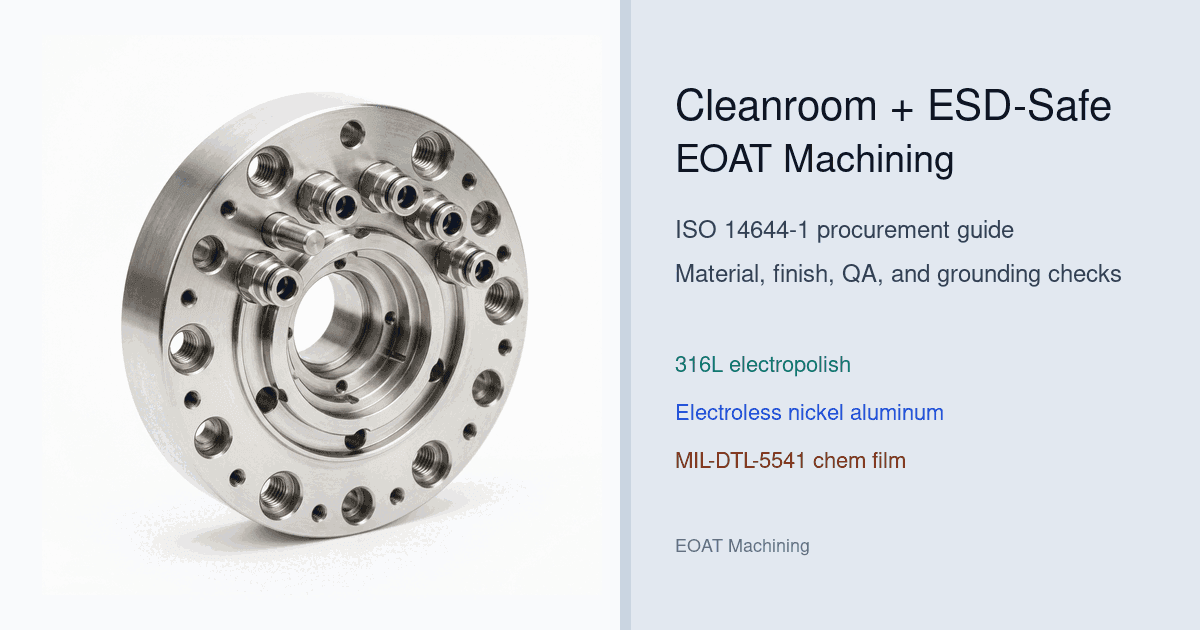
Cleanroom & ESD-Safe EOAT Machining: ISO 14644-1 Procurement Guide
Procurement guide to specify cleanroom and ESD-safe EOAT machining for ISO 14644-1 cells: compare finishes, risks, QA checks, and request DFM support.