
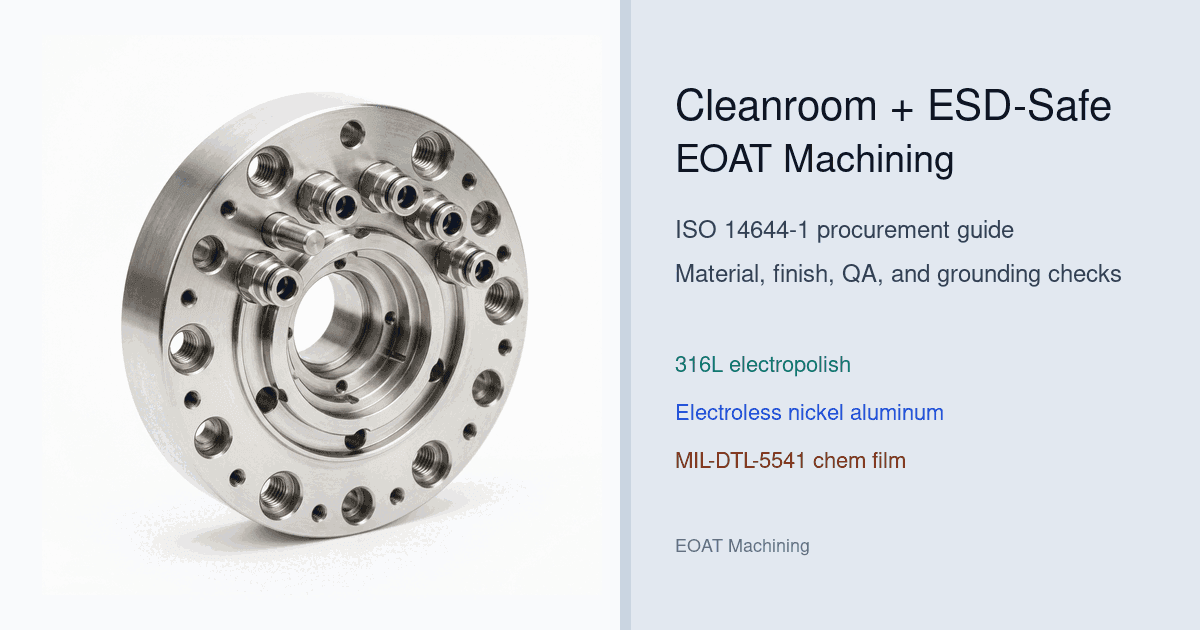
Cleanroom & ESD-Safe EOAT Machining: ISO 14644-1 Procurement Guide
Procurement guide to specify cleanroom and ESD-safe EOAT machining for ISO 14644-1 cells: compare finishes, risks, QA checks, and request DFM support.
Deploying robotic automation in semiconductor wafer fabrication, optical assembly, or medical device manufacturing introduces a unique procurement bottleneck: standard End-of-Arm Tooling (EOAT) will aggressively contaminate your cleanroom or destroy sensitive electronics via electrostatic discharge (ESD).
For procurement teams and automation engineers, sourcing custom grippers that meet both ISO 14644-1 (Cleanroom) and ANSI/ESD S20.20 (Electrostatic Discharge) standards is a complex balancing act. A gripper design that perfectly mitigates particulate shedding might inadvertently act as a static insulator, bridging a lethal voltage spike into a $5,000 microchip.
TL;DR (Executive Summary): To successfully deploy custom EOAT in ISO Class 4 or Class 5 cleanrooms, CNC machining must minimize particulate traps (no blind holes, strict surface roughness < 0.8 Ra). However, to remain ESD-safe, you cannot use standard Type II/III Aluminum Anodizing because it acts as an electrical insulator. The optimal procurement path involves specifying 316L Stainless Steel with electropolishing, or AL6061 with Electroless Nickel Plating / Chem Film (MIL-DTL-5541) to ensure both particulate control and a controlled dissipative path to ground.
This guide details the engineering boundaries, material selection, surface finishes, and supplier validation steps required to successfully source cleanroom-grade, ESD-safe EOAT.
1. The Dual Challenge: Particulates vs. Static Dissipation
When a robot moves at 2000 mm/s, the air turbulence shears microscopic particles off the EOAT surface. Simultaneously, the friction of the gripper pads against the workpiece generates a triboelectric charge.
The Cleanroom Goal
Prevent the generation and accumulation of airborne particulates. This means the EOAT must have smooth surfaces, zero outgassing, zero shedding of metallic flakes, and no internal geometries where air (and dust) can become trapped and subsequently exhausted during vacuum or pneumatic cycles.
The ESD Goal
Ensure a controlled resistance path (typically $10^5$ to $10^9$ ohms) from the contact tip of the gripper, through the EOAT chassis, into the robot's grounded wrist flange. If the resistance is too low (highly conductive), a rapid discharge can cause an EMP-like failure in the component. If the resistance is too high (insulative), static builds up until it arcs.
2. ISO 14644-1 Cleanroom Requirements for CNC Machined EOAT
The ISO 14644-1:2015 standard classifies cleanrooms based on the maximum allowable concentration of particles per cubic meter.
ISO 14644-1 Particulate Limits (Particles / m³ @ $\ge 0.1 \mu m$)
| Cleanroom Class | Max Particles ($\ge 0.1 \mu m$) | Max Particles ($\ge 0.5 \mu m$) | Typical Application |
|---|---|---|---|
| ISO 3 | 1,000 | 35 | Wafer Fabrication (Front-End) |
| ISO 4 | 10,000 | 352 | Semiconductor Packaging |
| ISO 5 | 100,000 | 3,520 | Optoelectronics, Advanced Medical |
| ISO 6 | 1,000,000 | 35,200 | Printed Circuit Board (PCB) Assembly |
| ISO 7 | 10,000,000 | 352,000 | General Medical Device Packaging |
Evidence Context: An improperly machined aluminum gripper with standard tapped holes can shed thousands of $0.5 \mu m$ aluminum oxide particles during a single threaded-fastener insertion, instantly violating an ISO 5 environment.
DFM Rules for Cleanroom Particulate Control
When submitting a CAD model for a cleanroom EOAT, the machining supplier must follow strict Design for Manufacturing (DFM) guidelines:
- No Blind Holes: Trapped air in blind tapped holes will "pump" out contaminants when a screw is inserted. All tapped holes should ideally be through-holes. If a blind hole is unavoidable, it must be vented.
- Surface Roughness (Ra): The surface finish must be uniformly smooth to prevent particles from adhering. We recommend a specification of Ra $\le 0.8 \mu m$ (32 $\mu in$).
- Generous Corner Radii: Sharp 90-degree internal corners trap dust and are difficult to clean. Specify minimum internal radii of 3mm or greater.
- Avoid Helicoils in High-Movement Areas: While Helicoils prevent thread galling, the friction of the insert against the parent material can generate micro-particulates under heavy vibration.
3. ANSI/ESD S20.20: The Conductivity Dilemma
According to the ANSI/ESD S20.20 standard, the grounding path for all conductors in the electrostatic protected area (EPA) must be less than 1 ohm, while the dissipative path for components should be carefully controlled.
The Problem with Aluminum Anodizing
The most common finish for machined aluminum EOAT is Type II or Type III (Hardcoat) Anodizing. Anodizing creates an aluminum oxide layer, which is a powerful electrical insulator. If you anodize an aluminum gripper chassis, the static charge generated at the gripper fingertips cannot flow through the chassis to the robot's ground. The charge builds up and arcs directly into the semiconductor.
Viable Surface Treatments for ESD + Cleanroom
To maintain both a non-shedding cleanroom surface and an ESD-compliant dissipative path, buyers must select alternative metal finishes.
| Surface Treatment | Base Material | Cleanroom Suitability | ESD Suitability | Cost / Lead Time |
|---|---|---|---|---|
| Electropolishing | 316L / 304 Stainless | Excellent (Removes micro-peaks, Ra $\le 0.4$) | Excellent (Naturally conductive) | High Cost, Slower |
| Electroless Nickel (EN) | AL6061 / AL7075 | Excellent (Hard, non-flaking) | Excellent (Conductive, uniform thickness) | Medium Cost |
| Chem Film (Alodine / MIL-DTL-5541) | AL6061 / AL7075 | Good (But can scratch under high friction) | Excellent (Maintains conductivity) | Low Cost, Fast |
| Passivation | 304 / 316L Stainless | Excellent (Improves corrosion resistance without coating buildup) | Excellent (Conductive base metal remains exposed) | Medium Cost |
| Type II/III Anodizing | AL6061 / AL7075 | Excellent (Seals pores, prevents shedding) | POOR (Acts as an electrical insulator) | Low Cost |
| Bare machined aluminum | AL6061 / AL7075 | Poor (Burrs, native oxide, and shop residue are hard to control) | Risky (Oxide growth can raise contact resistance) | Low Cost, Not Recommended |
Recommendation: For high-payload robots where weight matters, use AL6061-T6 aluminum with Electroless Nickel Plating (ENP). For medical/pharma or smaller payloads, use 304/316L Stainless Steel with Electropolishing.
4. Visualizing the Difference: Standard vs. Cleanroom EOAT
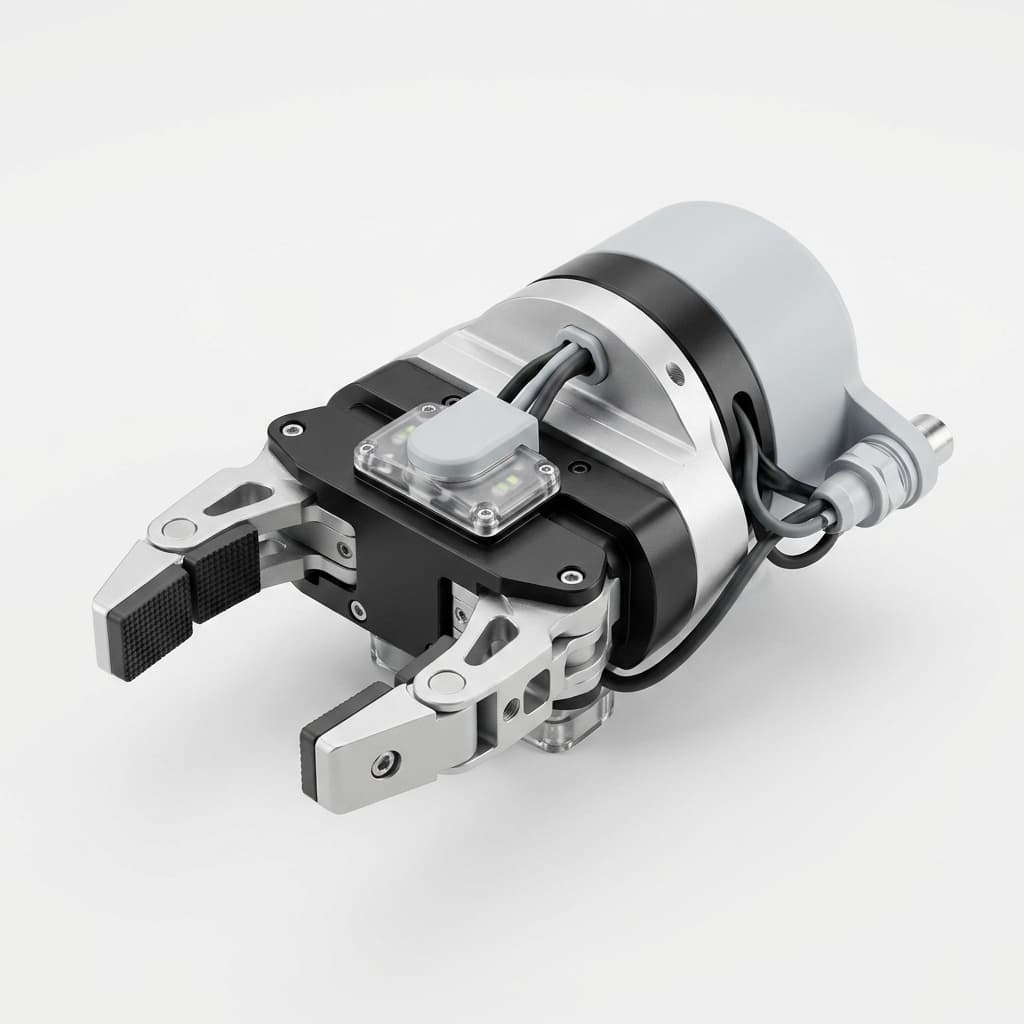
Below is an architectural breakdown of how a standard gripper design is modified for cleanroom and ESD compliance.
EOAT Design: Standard vs. Cleanroom (ISO 5) / ESD
Surface geometry and plating choices define the line between a successful cleanroom deployment and an expensive contamination failure.
5. Engineering Limitations & Risks
While the solutions above satisfy compliance, engineers must be aware of the mechanical trade-offs:
- Electroless Nickel Tolerance Buildup: ENP adds physical thickness to the part (typically $0.01mm$ to $0.025mm$ per surface). If your design relies on H7 reamed dowel holes for high-precision repeatability, the machinist must pre-machine the holes oversized to account for the plating thickness, or plug the holes during plating.
- Stainless Steel Weight Penalties: 316L Stainless Steel is almost 3 times heavier than Aluminum. On a collaborative robot (Cobot) like the UR10e with a 12.5kg payload limit, a stainless steel gripper chassis can consume 40% of your payload budget, significantly reducing robot acceleration.
- Chem Film Durability: While MIL-DTL-5541 (Alodine) is cheap and conductive, it is extremely thin and scratches easily. Repeated mating cycles of a Quick-Change Tooling (QCT) plate can wear through the Chem Film, generating aluminum dust.
6. Procurement & Engineering Checklist
Before cutting purchase orders for cleanroom-grade EOAT, audit your CNC machining supplier with this checklist:
- Material Certification: Supplier provides MTRs (Material Test Reports) tracing the exact alloy lot.
- Plating Certification: Supplier provides a Certificate of Conformance (CoC) confirming Electroless Nickel or Passivation, with coverage and blistering expectations stated in the acceptance criteria.
- DFM Validation: Supplier's CAM engineer has verified the removal of all unvented blind holes.
- Surface Finish Verification: Supplier documents the Ra $\le 0.8\mu m$ target and can provide a profilometer report upon request.
- Packaging: Final parts are ultrasonic cleaned, sealed in anti-static PE bags, and shipped clean (no oily rust-inhibitors applied).
7. Frequently Asked Questions (FAQ)
Q: Can we use 3D printing for cleanroom EOAT? A: Rarely. FDM printing creates microscopic layer lines (anisotropic structures) that trap contaminants and are impossible to wipe clean. SLA/SLS resins can outgas VOCs in a vacuum. If printing is strictly necessary, use highly controlled Polycarbonate or PEEK, followed by vapor smoothing to seal the surface. However, CNC machining remains the gold standard for ISO 5 and below.
Q: Does black anodizing shed more particles than clear anodizing? A: The dye in black anodizing does not significantly increase particle shedding, but all standard anodizing acts as an insulator, breaking ESD compliance. If you need a black surface for vision-guided robotics (VGR) in a cleanroom, explore black electroless nickel or specialized black chrome plating.
Q: How do we handle pneumatic actuators and suction cups in a cleanroom? A: Machined components are only half the battle. You must source cleanroom-rated pneumatic cylinders (which use specialized non-shedding seals and exhaust filtration) and ESD-safe dissipative suction cups (typically made of carbon-impregnated NBR or Silicone).
8. Sources and References
- ISO 14644-1:2015: Cleanrooms and associated controlled environments — Part 1: Classification of air cleanliness by particle concentration. International Organization for Standardization.
- ANSI/ESD S20.20-2021: Standard for the Development of an Electrostatic Discharge Control Program for Protection of Electrical and Electronic Parts, Assemblies and Equipment. ESD Association.
- MIL-DTL-5541: Chemical conversion coatings for aluminum and aluminum alloys, relevant when specifying conductive Chem Film / Alodine finishes. Defense Logistics Agency QuickSearch.
Secure Your Supply Chain with Compliant EOAT Machining
The gap between a prototype gripper and an ISO-compliant production tool is measured in surface finishes, material science, and rigorous quality control.
At EOAT Machining, we specialize in high-precision CNC machining for semiconductor, medical, and optical automation integrators. We understand the stringent requirements of ISO 14644-1 and ANSI/ESD S20.20.
Don't let a poorly plated aluminum bracket fail your cleanroom audit. Contact our engineering team today for a DFM review and a rapid quotation on your cleanroom-grade end effectors.
Author

More Posts
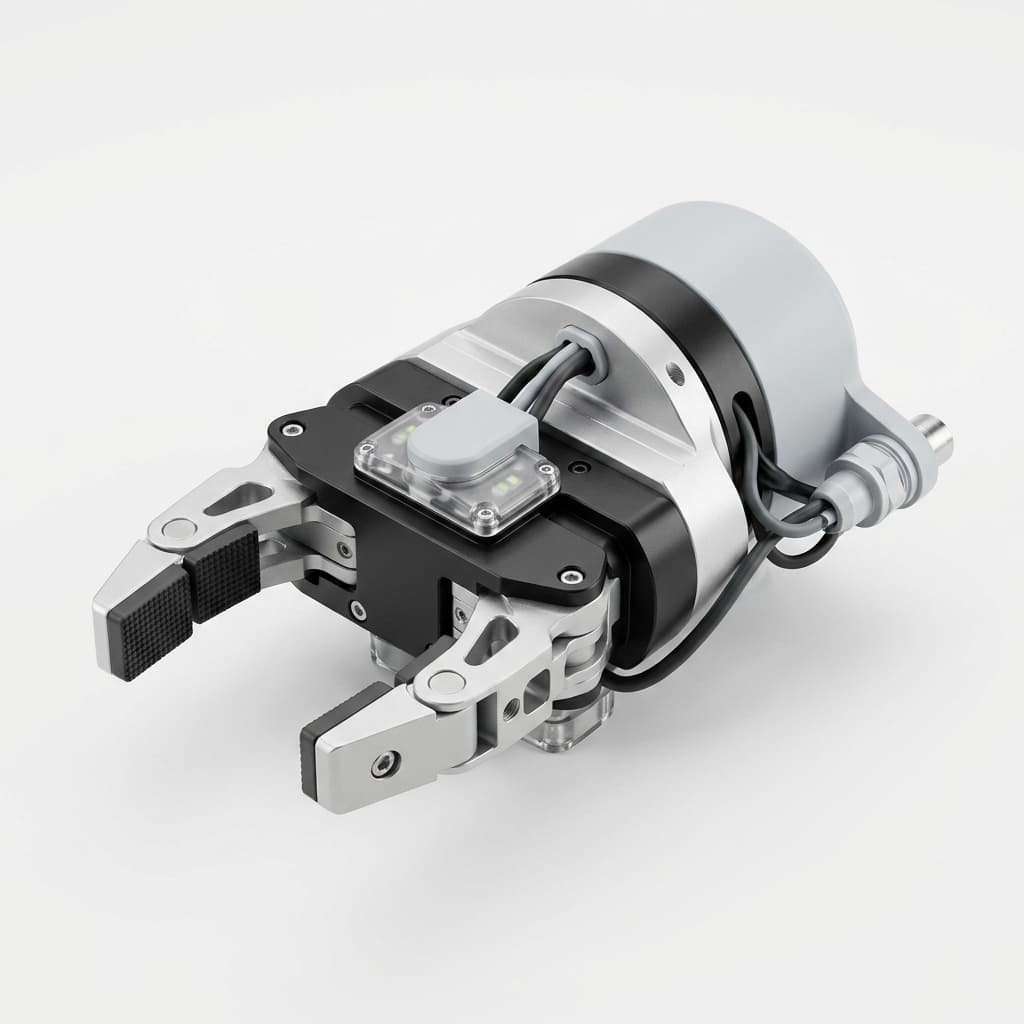
Custom CNC Machining for AI Vision-Guided EOAT: Calibration Stability and Procurement Guide
Prevent hand-eye calibration drift in vision-guided EOAT with CNC machined camera mounts, DFM rules, tolerance notes, and an RFQ checklist.
EOAT Machining Tolerances and Surface Finishes: A Buyer's Guide
Use this EOAT machining buyer's guide to set practical tolerances, surface finishes, ISO 2768 notes, and RFQ checks before quoting custom tooling.
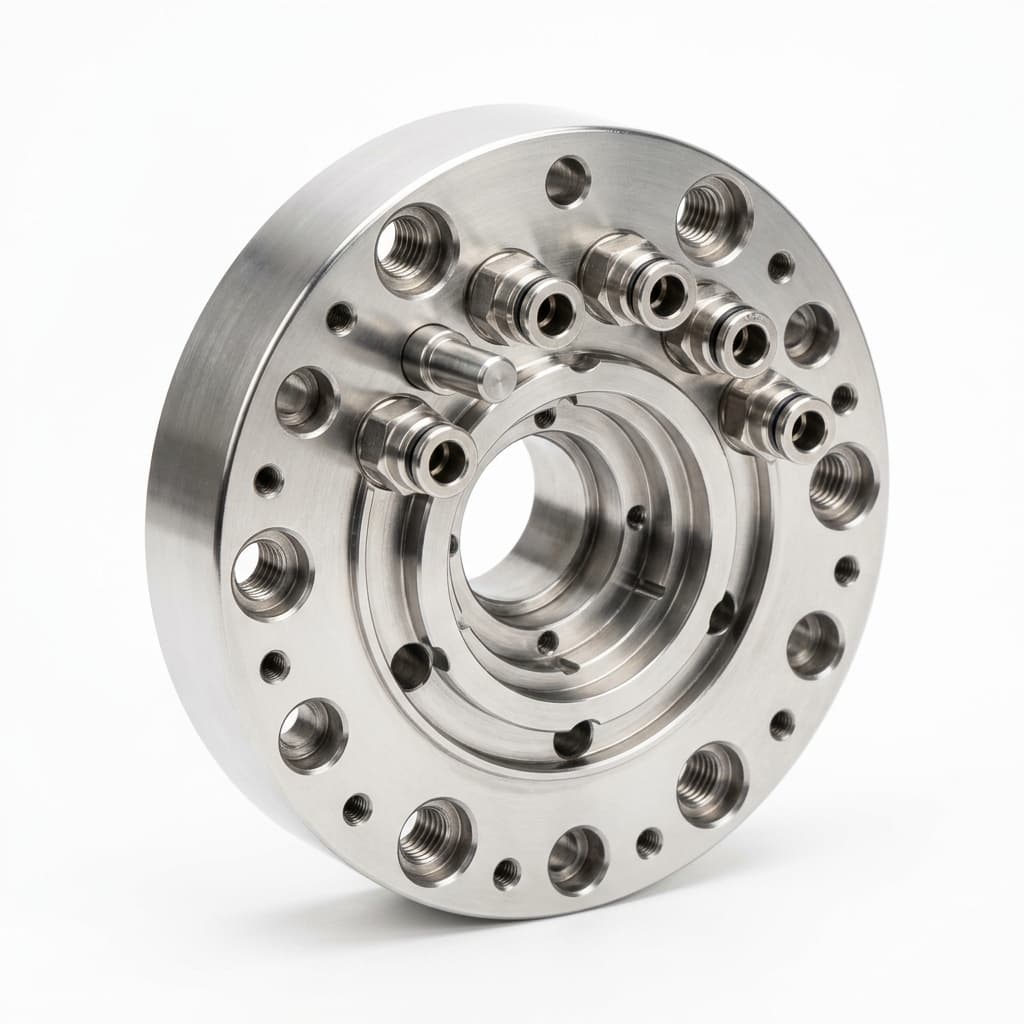
Robotic Automatic Tool Changers (ATC): Machining Tolerances and Procurement Specs for EOAT
Specify robotic Automatic Tool Changers for EOAT machining: repeatability, fail-safe locks, utility ports, payload moments, and supplier QA checks.