
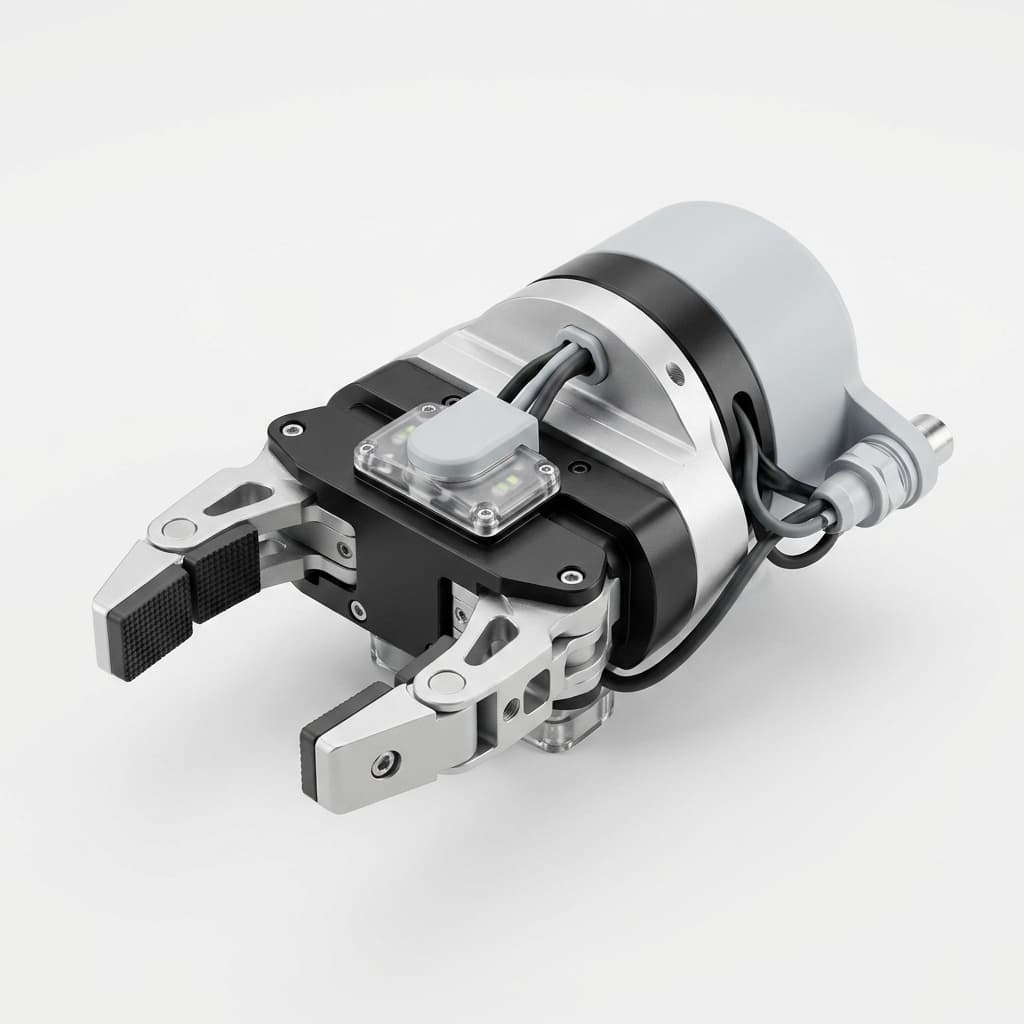
How ISO 10218:2025 Updates Change EOAT Safety and Compliance in Machining
Discover how the new ISO 10218-1:2025 and ISO 10218-2:2025 standards merge collaborative robot safety into a unified framework, and what it means for end-of-arm tooling in CNC machining.
The release of the revised ISO 10218:2025 series marks a significant shift for industrial robotics, officially retiring the standalone cobot safety guidelines (ISO/TS 15066) and integrating them into a unified global standard. For procurement teams, engineers, and integrators deploying End-of-Arm Tooling (EOAT) in CNC machining, this changes how safety compliance is assessed, documented, and verified.
Decision-Level Executive Summary: The new ISO 10218-1:2025 and ISO 10218-2:2025 (and the US adoption ANSI/A3 R15.06-2025) officially consolidate traditional industrial robot and collaborative robot (cobot) safety standards. For CNC machining deployments, EOAT is no longer evaluated under separate "cobot rules"; it must comply with the unified ISO 10218-2:2025 framework, specifically focusing on Power and Force Limiting (PFL) metrics, sharp edges, and energy hazards unique to machining environments. Buyers should update their compliance specifications immediately for any cells being deployed in 2026 and beyond.
What Changed: The 2025 Standard Evolution
For nearly a decade, the robotics industry operated on a "dual-track" system. Traditional industrial robots were governed by the 2011 versions of ISO 10218, while collaborative robots relied on the technical specification ISO/TS 15066 (and RIA TR R15.606).
The new revisions published in early 2025 fundamentally change this structure. Instead of classifying the robot, the standard now focuses on classifying the application.
Key Updates Summary Table
| Compliance Dimension | Previous Framework (Pre-2025) | New Framework (ISO 10218:2025) | Buyer Impact |
|---|---|---|---|
| Core Safety Standard | ISO 10218-1/2:2011 | ISO 10218-1/2:2025 | Procurement must specify the 2025 standard for new EOAT purchases. |
| Collaborative Guidance | ISO/TS 15066 (Standalone) | Fully integrated into ISO 10218-2:2025 | "Cobot" is no longer a distinct safety category; the focus is on "collaborative applications." |
| Robot Classification | Generic Industrial vs. Cobot | Class I (inherently lower risk) & Class II | Clearer guidelines for integrating smaller payload EOATs versus heavy CNC loaders. |
| Functional Safety (PL) | Implied / Generic PL d/Cat 3 | Explicit Performance Levels (PL) assigned via Appendix C | Safety functions like "monitored standstill" require specific PL verification from EOAT vendors. |
| Cybersecurity | Not formally required | Explicitly included in safety planning | Networked smart grippers must now undergo cybersecurity risk assessments. |
| Mobile Platforms | Loosely defined | Formally defined and aligned with AGV standards | Clearer integration pathways for EOATs mounted on mobile manipulators. |
| PFL Design Testing | Unstandardized test methods | Standardized test methodology to determine max force | Buyers must ask for empirical biomechanical test data under the new Class I limits. |
| EU Machinery Reg | Aligned with old directives | Harmonized with the new EU Machinery Regulation | Crucial for global buyers deploying standard cells across EU and US facilities. |
| Transition Period | N/A | Regional adoptions rolling out 2025-2026 | New deployments should target the 2025 spec to avoid rapid obsolescence. |
The Unified Safety Framework Architecture
Safety Standard Evolution: Dual-Track to Unified
Impact on EOAT Design in CNC Machining
In CNC machine tending operations, end effectors regularly handle sharp metallic billets, heavy castings, and tools covered in cutting fluids. The shift to ISO 10218-2:2025 brings specific scrutiny to these elements.
1. Re-evaluating Pinch Points and Sharp Edges
Under the new standard, relying solely on the robot arm's internal force sensors is insufficient. The EOAT itself must be designed to minimize biomechanical injury risks during transient and quasi-static contact. If a gripper handling a sharp machined part cannot natively limit force to safe levels upon impact, secondary safety measures (like area scanners or safety mats) must be integrated into the cell design.
2. High-Payload Machining Considerations
For heavier machining applications, the standard's updated Power and Force Limiting (PFL) metrics require rigorous validation. The payload mass (the machined part + the EOAT) contributes to the total kinetic energy of the system. Integrators must prove that the combined mass, when moving at programmed speeds, falls within the acceptable energy thresholds defined in the updated biomechanical limits annex.
3. Application-Level Cyber-Physical Risks
With smart grippers incorporating IO-Link and ethernet communications, ISO 10218-2:2025 explicitly includes cybersecurity as a physical safety concern. A cyber intrusion that alters a pneumatic valve's actuation timing or a servo gripper's grip force during a CNC load sequence can result in a dropped payload or an unexpected release, triggering a physical safety hazard.
4. Appendix C: Mandatory Performance Levels (PL)
Under the previous standard, integrators often defaulted to a blanket "PL d, Category 3" for all safety functions. ISO 10218-2:2025 introduces a structured Appendix C, which lists safety functions and assigns them specific, appropriate performance levels. For CNC machining, this means pneumatic interlocks and vacuum pressure monitors on your EOAT must be strictly validated against these new granular PL requirements.
Risks, Constraints, and Limits
While the standards have been simplified into a single framework, compliance has not necessarily become easier. Buyers must be aware of the following constraints:
- Biomechanical Limits Still Apply: The merging of ISO/TS 15066 into ISO 10218-2:2025 does not mean the stringent force/pressure limits have been abolished. They are now formally embedded as normative requirements for collaborative applications.
- Material Handling Hazards: The standard governs the robot system, but the workpiece remains a wild card. Handling an unmachined aluminum block is low risk; handling a freshly machined block with razor-sharp burrs immediately invalidates many collaborative safety assumptions unless properly mitigated.
- Transition Timeline: While published in 2025, regional adoptions (like DIN EN ISO in Europe and ANSI/A3 in the US) are rolling out through 2026. Global deployments may experience temporary regulatory friction depending on the local jurisdiction's adoption speed.
EOAT Compliance Analysis Flow
PFL Assessment Flow for Machining EOAT
Action Checklist for Buyers and Engineers
To ensure smooth transitions and avoid costly retrofits, procurement teams and automation engineers should implement the following steps:
- Update RFQ Templates: Update all Request for Quotes (RFQs) to explicitly demand compliance with ISO 10218-2:2025 (or ANSI/A3 R15.06-2025) rather than referencing the outdated ISO/TS 15066.
- Request Cybersecurity Documentation: For smart EOAT devices, demand vendor documentation outlining the cybersecurity measures protecting actuation and grip-force signals.
- Verify Performance Levels (PL): Ensure that the EOAT components providing critical safety functions (such as safety valves or pressure monitors) carry explicit PL certifications.
- Conduct Application-Specific PFL Testing: Mandate that integrators perform physical biomechanical testing with the actual machined parts, not just the bare gripper.
- Review System Integration Boundaries: Clarify with system integrators whether the robotic cell falls under Class I or Class II risk categories, as this determines the rigorousness of the required safety interlocks.
Frequently Asked Questions (FAQ)
Q: Does my existing cobot cell running under ISO/TS 15066 need immediate retrofitting? A: Typically, standards are not retroactive for already deployed and commissioned machinery unless a significant modification or relocation occurs. However, you should consult with your corporate safety officer.
Q: Can I still buy a "collaborative robot"? A: Yes, hardware vendors will still market robots as "collaborative" or "cobots." However, legally and technically under the standard, you are certifying a collaborative application, not just buying a safe robot. A safe cobot holding a dangerous sharp tool is an unsafe application.
Q: Are there changes to the specific pressure limit numbers (N/cm²)? A: The core biomechanical data derived from the University of Mainz studies remains the foundation. However, ISO 10218-2:2025 refines how these limits are applied within the broader risk assessment framework. Always refer to the most recent annexes for exact limit calculations.
Q: How does ANSI/A3 R15.06-2025 relate to ISO 10218:2025? A: ANSI/A3 R15.06-2025 is the US national adoption of the ISO standards. For practical engineering purposes, complying with the ISO baseline ensures compliance with the ANSI standard.
Sources
- ISO 10218-1:2025 (Robots and robotic devices — Safety requirements — Part 1): Requirements for robot manufacturers (Published February 2025). ISO Store: 10218-1:2025
- ISO 10218-2:2025 (Robots and robotic devices — Safety requirements — Part 2): Integration guidelines absorbing collaborative operations (Published February 2025). ISO Store: 10218-2:2025
- ANSI/A3 R15.06-2025: Association for Advancing Automation (A3) national adoption updates replacing the 2012 edition. automate.org
- TÜV Rheinland Safety Standard Insights: Whitepapers on functional safety transitions and the integration of cybersecurity into physical safety models. tuv.com
Author

Categories
More Posts
Custom CNC Machining for AI Vision-Guided EOAT: Calibration Stability and Procurement Guide
Prevent hand-eye calibration drift in vision-guided EOAT with CNC machined camera mounts, DFM rules, tolerance notes, and an RFQ checklist.
Robotic Automatic Tool Changers (ATC): Machining Tolerances and Procurement Specs for EOAT
Specify robotic Automatic Tool Changers for EOAT machining: repeatability, fail-safe locks, utility ports, payload moments, and supplier QA checks.
Cleanroom & ESD-Safe EOAT Machining: ISO 14644-1 Procurement Guide
Procurement guide to specify cleanroom and ESD-safe EOAT machining for ISO 14644-1 cells: compare finishes, risks, QA checks, and request DFM support.