
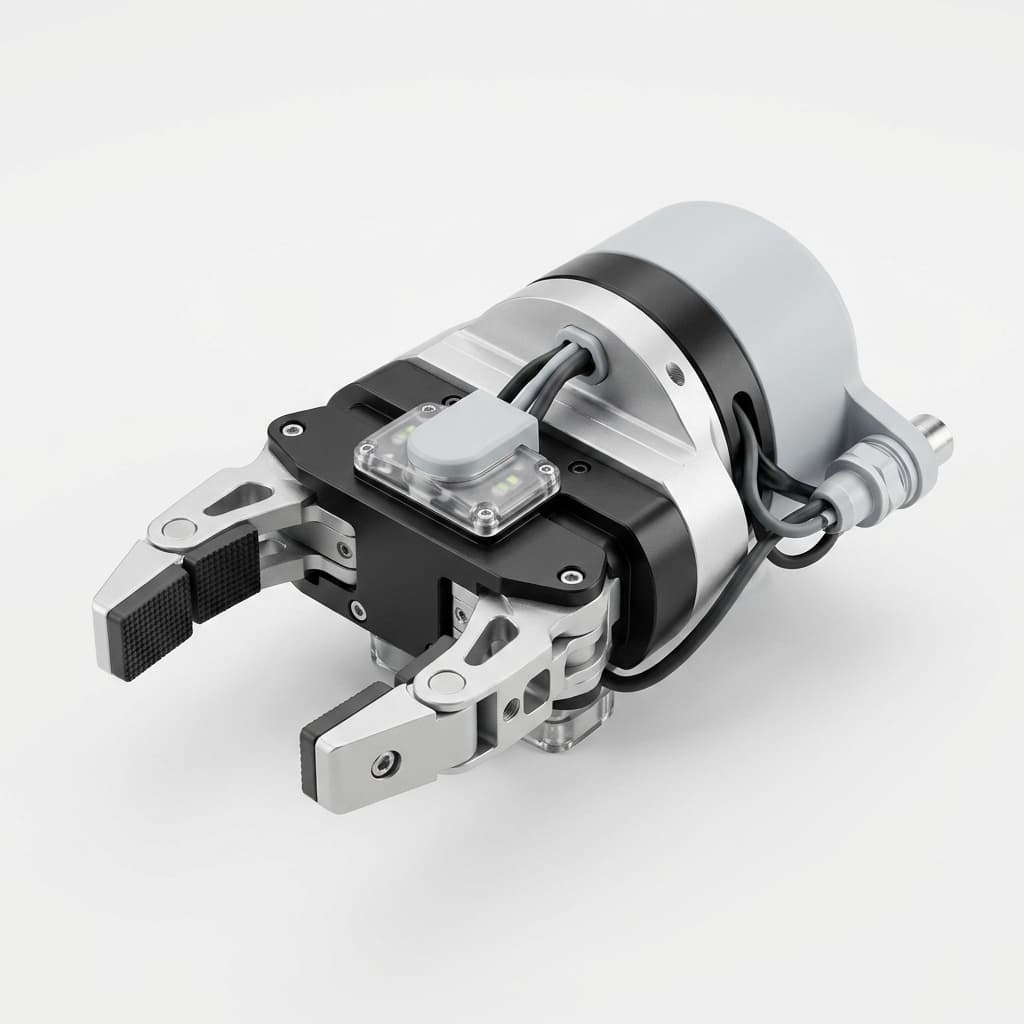
EOAT Machining Tolerances and Surface Finishes: A Buyer's Guide
Use this EOAT machining buyer's guide to set practical tolerances, surface finishes, ISO 2768 notes, and RFQ checks before quoting custom tooling.
Every procurement manager and mechanical engineer in robotics eventually faces the same dilemma: quotes for custom end-of-arm tooling (EOAT) components returning at three to four times the expected budget. In almost all of these cases, the primary cost driver is not the raw material, nor is it the basic geometry of the gripper. The real culprit is hiding in the title block of the 2D manufacturing drawing.
When engineers apply a blanket tolerance of ±0.01 mm to an entire robotic gripper, or demand a mirror-like Ra 0.2 µm surface finish on non-mating exterior faces, they inadvertently trigger what is known in the advanced manufacturing industry as the "Precision Penalty."
TL;DR (Executive Summary): Tighter machining tolerances drive up custom EOAT costs exponentially, not linearly. By adopting ISO 2768 for general dimensions, utilizing proper GD&T, and understanding that perfect "mirror finishes" can actually cause pneumatic seal failures, procurement teams can avoid paying for non-functional precision while simultaneously improving field reliability and reducing lead times.
This comprehensive, evergreen guide is specifically designed for buyers, procurement teams, importers, and robotics engineers who need to bridge the gap between functional automation design and cost-effective CNC manufacturing. We will break down exactly how precision drives pricing, when to truly specify high-end surface finishes, the impact of material selection on machinability, and how to structure your Request for Quote (RFQ) to extract the absolute best value from your machining partner.
Scope and limits: This guide applies to CNC-machined EOAT plates, gripper bodies, jaws, vacuum manifolds, pneumatic details, and robot-side adapters used in global automation programs. It is not a replacement for an application-specific tolerance stack-up, safety review, robot OEM interface drawing, or regulated hygienic-design validation. Treat the ranges below as RFQ review defaults: tighten them only when the feature controls location, sealing, bearing life, payload rigidity, or repeatable tool change.
1. The Precision Penalty: Why Tighter Tolerances Break Budgets
It is a common misconception among junior engineers and non-technical buyers that moving from a standard ±0.1 mm tolerance to a high-precision ±0.01 mm tolerance requires just a "little bit more time" on the CNC milling machine. In reality, the relationship between dimensional precision and manufacturing cost is highly exponential.
What Drives This Exponential Cost Escalation?
When an engineer specifies a tolerance tighter than ±0.05 mm on a drawing, several disruptive events occur on the manufacturing shop floor:
- Slower Feed Rates and Speeds: The CNC machine must run significantly slower to prevent microscopic tool deflection. High material removal rates (MRR) are sacrificed for dimensional stability.
- Multiple Pass Operations: The part can no longer be finished with a standard aggressive end mill. It now requires a roughing pass to remove bulk material, a semi-finishing pass to relieve internal stresses, and finally a highly controlled finishing pass or even secondary cylindrical grinding.
- Rigid Environmental Controls: Metals expand and contract dynamically with temperature changes. Hitting a true ±0.005 mm tolerance requires an environmentally controlled machining center, rigorous spindle coolant temperature management, and climate-controlled metrology labs.
- Advanced Metrology and Quality Control (QC): You are no longer measuring the finished component with standard digital calipers. The machine shop must use expensive Coordinate Measuring Machines (CMM), optical comparators, or precision micrometers. This adds significant manual labor to the inspection process for every single part.
- Elevated Scrap Rates: The risk of a part failing inspection increases dramatically as the tolerance window shrinks. The machine shop mathematically bakes this anticipated scrap rate directly into your quote, meaning you pay for the parts they throw away.
2. Using ISO 2768 to Your Advantage
One of the most effective ways for a procurement team to instantly reduce EOAT machining costs is to ensure their engineering team is aggressively utilizing ISO 2768.
ISO 2768 is a globally recognized international standard that provides general tolerances for linear and angular dimensions. By simply writing "ISO 2768-mK" in the title block of a CAD drawing, the engineer sets a reasonable, standard tolerance for every feature on the part that does not have a specific, tighter tolerance explicitly called out.
This simple notation acts as a permission slip for the machinist. It allows them to run the bulk of the gripper body—the non-critical exterior profiles, the clearance holes, the weight-reduction pockets—at fast, economical speeds, and only slow the machine down for the critical alignment dowels or bearing press fits that actually dictate the performance of the robot.
Geometric Dimensioning and Tolerancing (GD&T) vs. Coordinate Dimensioning
A related strategy is transitioning from basic coordinate dimensioning to proper GD&T. Instead of constraining a hole's exact X and Y position to an impossible standard, GD&T allows engineers to define a "true position" tolerance zone. This circular tolerance zone provides 57% more manufacturing margin for the machinist while still guaranteeing that the mating bolt will pass through perfectly. Procurement teams should favor suppliers and engineering teams that speak fluent GD&T, as it inherently lowers production costs.
3. EOAT Machining Features vs. Required Tolerances
To help procurement teams audit their inbound RFQs before sending them to suppliers, we have compiled a comprehensive guideline for common robotic tooling features and the tolerances they actually require for field success.
| EOAT Component Feature | Typical Required Tolerance | Manufacturing Method | Cost Impact | Procurement & Engineering Advice |
|---|---|---|---|---|
| Clearance Holes (Bolts) | ± 0.1 mm to ± 0.2 mm | Standard Drilling | Low | Do not over-specify. Bolts strictly need room to clear the shank. |
| Outer Gripper Body | ISO 2768-m (± 0.2 mm) | Rough / Finish Milling | Low | Purely aesthetic or for gross clearance; let the shop run fast. |
| Vacuum Manifold Faces | ± 0.05 mm | Precision Milling | Moderate | Needs flatness for O-ring sealing, but not extreme micro-tolerances. |
| Robot Flange Interface | ± 0.02 mm (Locating) | Precision Milling | High | The ISO 9409-1 robot wrist connection is critical. Invest money here. |
| Dowel Pin Holes | +0.01 / -0.00 mm (H7) | Drilling then Reaming | High | Justify these. Only use for critical alignment of modular jaws. |
| Bearing Press Fits | +0.005 / -0.00 mm | Boring or Grinding | Very High | Necessary for moving pivots, but isolate them to the smallest area. |
| Sensor Mounting Slots | ± 0.1 mm | Standard Milling | Low | Proximity sensors are adjustable. Do not machine slots to tight tolerances. |
| Threaded Holes (Tapped) | Standard 6H / 2B | Tapping | Low | Stick to standard metric pitches. Custom threads require expensive custom taps. |
| O-Ring Static Grooves | ± 0.05 mm | Precision Milling | Moderate | Depth is critical for squeeze, but groove width has much more forgiveness. |
4. Surface Finishes: Why "Mirror Smooth" Can Break Pneumatic Grippers
Surface finish in machining is typically denoted by the "Ra" value (Roughness Average), measured in micrometers (µm) or microinches (µin). A lower Ra value indicates a microscopically smoother surface.
Many engineers fall into the trap of specifying a blanket Ra 0.8 µm (32 µin) or even a polished Ra 0.4 µm (16 µin) across the entire end-of-arm tool "just to make it look premium." This not only spikes the manufacturing cost due to required secondary finishing passes, but in certain pneumatic applications, it can actually cause catastrophic tool failure.
The Paradox of Dynamic Seals in Automation
End-of-arm tooling relies heavily on integrated pneumatics—custom cylinders, vacuum ejector cartridges, and blow-off channels. If you are machining a custom pneumatic cylinder directly into an aluminum EOAT body (a common space-saving tactic), you might instinctively assume that smoother is better to reduce friction against the piston seal.
This is a critical engineering mistake.
Dynamic pneumatic seals (like polyurethane cup seals or nitrile O-rings) require a very thin, consistent film of lubricant to function correctly. If the cylinder bore surface is machined, honed, or polished to a perfect mirror finish (e.g., Ra < 0.1 µm), there are no microscopic "valleys" left in the metal to hold the oil or pneumatic grease. The seal will wipe the surface completely dry on the first few strokes, resulting in:
- High "stiction" (breakaway friction causing jerky robot movements).
- Rapid heat generation due to dry sliding friction.
- Premature seal degradation, tearing, and inevitable air leakage.
Proper Surface Finish Specifications for EOAT
- Dynamic Rod/Piston Surfaces: Ra 0.1 – 0.3 µm. Smooth, but with enough micro-texture to retain a lubricating film.
- Dynamic Bore Surfaces: Ra 0.1 – 0.5 µm. Often achieved via roller burnishing or precision honing.
- Static O-Ring Grooves: Ra 0.8 – 1.6 µm. The rubber O-ring naturally deforms into the groove under pressure; a perfectly smooth finish here is an expensive waste of machining time.
- Non-Mating Exterior Faces: Ra 1.6 – 3.2 µm. A standard, highly economical milled finish that looks professional but costs nothing extra.
5. Material Selection and Its Impact on Tolerance
Procurement teams must also recognize that not all materials hold tolerances equally well. Specifying an incredibly tight tolerance on a material that moves or flexes is a waste of capital.
- Aluminum (6061-T6 and 7075-T6): The undisputed kings of EOAT machining. They are highly machinable, lightweight, and hold tolerances very well. 7075 offers aerospace-grade strength, while 6061 is highly economical.
- Stainless Steel (304 / 316L): Required for food-grade, medical, or harsh washdown environments (IP69K). However, they are tough to machine, wear down tools quickly, and hold heat, making tight tolerances significantly more expensive to achieve.
- Engineering Plastics (Acetal/POM, PEEK): Excellent for non-marring contact pads and lightweight structural bodies. However, plastics have higher coefficients of thermal expansion and can relieve internal stresses after machining, causing them to warp slightly. Specifying a ±0.01 mm tolerance on a large Delrin part is often a futile and expensive exercise, as the part will change dimensions based on the ambient temperature of the factory floor.
6. The Buyer's RFQ Optimization Checklist
Before releasing a custom EOAT drawing or CAD package out for quote, procurement teams, sourcing managers, and manufacturing engineers should run through this checklist to ensure they aren't paying the unnecessary "Precision Penalty."
- Title Block Audit: Does the drawing utilize a general tolerance standard like ISO 2768-mK? If every single dimension has a manual ±0.01mm callout, return it to the engineering department for revision.
- Feature Isolation: Are ultra-tight tolerances (like H7 reamed holes or bearing press fits) restricted only to the critical mating features?
- Surface Finish Reality Check: Are we asking for Ra 0.4 µm on non-contact structural surfaces? Limit high-finish callouts strictly to dynamic sealing faces or aesthetic, customer-facing panels.
- Internal Radii Check (DFM): Do internal milled pockets have sharp, 90-degree corners? Sharp corners require tiny, fragile end mills that slow down production dramatically. Ensure all internal pockets have a generous corner radius (e.g., R3 or greater) to allow larger tools to clear material faster.
- Standard Hardware & Threads: Are the threaded holes standard metric (M3, M4, M5, M6) or standard imperial? Specifying non-standard thread pitches requires the shop to order custom taps, adding cost and lead time.
- Material Suitability: Are we specifying an exotic aerospace alloy when standard 6061-T6 Aluminum or Acetal (POM) would provide more than sufficient yield strength for the payload?
- Deep Hole Drilling: Does the design require deep, narrow vacuum channels? Holes with a depth-to-diameter ratio greater than 10:1 are very difficult to machine and prone to tool breakage. Consider splitting the part or using cross-drilled intersecting holes.
7. Value Engineering: Partnering with the Right Machining Provider
Procuring custom end-of-arm tooling is fundamentally different from buying high-volume, standardized consumer goods. It requires a manufacturing partner who doesn't just execute the provided G-code blindly, but actively engages in transparent Design for Manufacturing (DFM).
A high-quality machining partner will look at an over-constrained drawing and, instead of simply quoting an exorbitant price to cover their risk, will schedule a quick consultation to ask: "Do you really need this non-mating exterior face held to five microns, or can we open it up to standard tolerances and save you $400 per unit?"
This collaborative approach separates order-takers from true manufacturing partners.
8. Frequently Asked Questions (FAQ) for Sourcing EOAT
Q: Does tightening machining tolerances improve the overall lifespan of my robot gripper?
A: Only if the specific tolerance directly impacts a functional mechanical fit, such as a bearing journal, a dynamic pneumatic seal, or a locating dowel for repeated jaw swaps. Tightening tolerances on external profiles, sensor mounts, or clearance holes adds zero functional lifespan to the tool and significantly inflates the purchase price.
Q: What is the standard Ra surface finish I can expect from CNC milling without incurring extra costs?
A: Most reputable CNC machine shops can comfortably hold an Ra 1.6 µm to Ra 3.2 µm (63-125 µin) standard finish using sharp, modern carbide tools and standard feed rates. Anything smoother than Ra 0.8 µm usually requires significantly slower finishing passes, specialized tool geometries, or secondary polishing operations.
Q: Why do my custom vacuum manifolds keep leaking despite specifying very tight dimensional tolerances?
A: Vacuum leaks are far more often caused by poor surface finish across the sealing face (preventing the O-ring or gasket from seating properly) or by inherent porosity in the material block, rather than dimensional inaccuracy. Ensure the mating faces have parallel lay marks or specify a circular tool path to trap the vacuum, rather than just asking for tighter numbers.
Q: Is it cheaper to 3D print EOAT components instead of CNC machining them?
A: It depends entirely on the application. For complex, low-stress, highly organic geometries (like conformal suction manifolds or lightweight cobot payload adapters), 3D printing is often cheaper and faster. However, for high-payload, high-cycle environments requiring extreme rigidity, metal thread strength, and repeatable locating datums, CNC machining remains the gold standard. In production scenarios, machining often offers a lower total cost of ownership over millions of cycles.
Q: How do secondary operations like anodizing affect my precision tolerances?
A: Hardcoat anodizing (Type III) typically adds about 0.025 mm to 0.05 mm (0.001" to 0.002") of thickness to the surface of aluminum parts. If you have an extremely tight H7 dowel hole, you must explicitly tell the machine shop to either mask the hole during the anodizing process or machine the hole oversized to account for the coating build-up. Failure to account for plating thickness is a leading cause of assembly failures.
Ready to Optimize Your Robotic Tooling Costs?
Stop overpaying for manufacturing precision you don't actually need. Our engineering and machining teams specialize in producing high-performance, cost-effective end-of-arm tooling tailored specifically for the automation industry. We meticulously review every CAD file and 2D drawing for DFM opportunities, ensuring you get the exact field performance you require without the hidden "Precision Penalty."
Upload your CAD and Request a DFM Consultation Today →
Sources / References
- CNC Machining Tolerances and Cost Drivers: Engineering guidance explaining why tighter CNC tolerances change machining strategy, inspection burden, and quote risk. Protolabs
- ISO 2768 General Tolerances: Official ISO page for the general tolerance standard covering linear and angular dimensions without individual tolerance indications. ISO
- Surface Finish Requirements for Seals: Seal-design guidance on specifying surface roughness ranges for static and dynamic elastomer sealing surfaces. Apple Rubber
Author

Categories
More Posts
Custom CNC Machining for AI Vision-Guided EOAT: Calibration Stability and Procurement Guide
Prevent hand-eye calibration drift in vision-guided EOAT with CNC machined camera mounts, DFM rules, tolerance notes, and an RFQ checklist.
Cleanroom & ESD-Safe EOAT Machining: ISO 14644-1 Procurement Guide
Procurement guide to specify cleanroom and ESD-safe EOAT machining for ISO 14644-1 cells: compare finishes, risks, QA checks, and request DFM support.
Robotic Automatic Tool Changers (ATC): Machining Tolerances and Procurement Specs for EOAT
Specify robotic Automatic Tool Changers for EOAT machining: repeatability, fail-safe locks, utility ports, payload moments, and supplier QA checks.